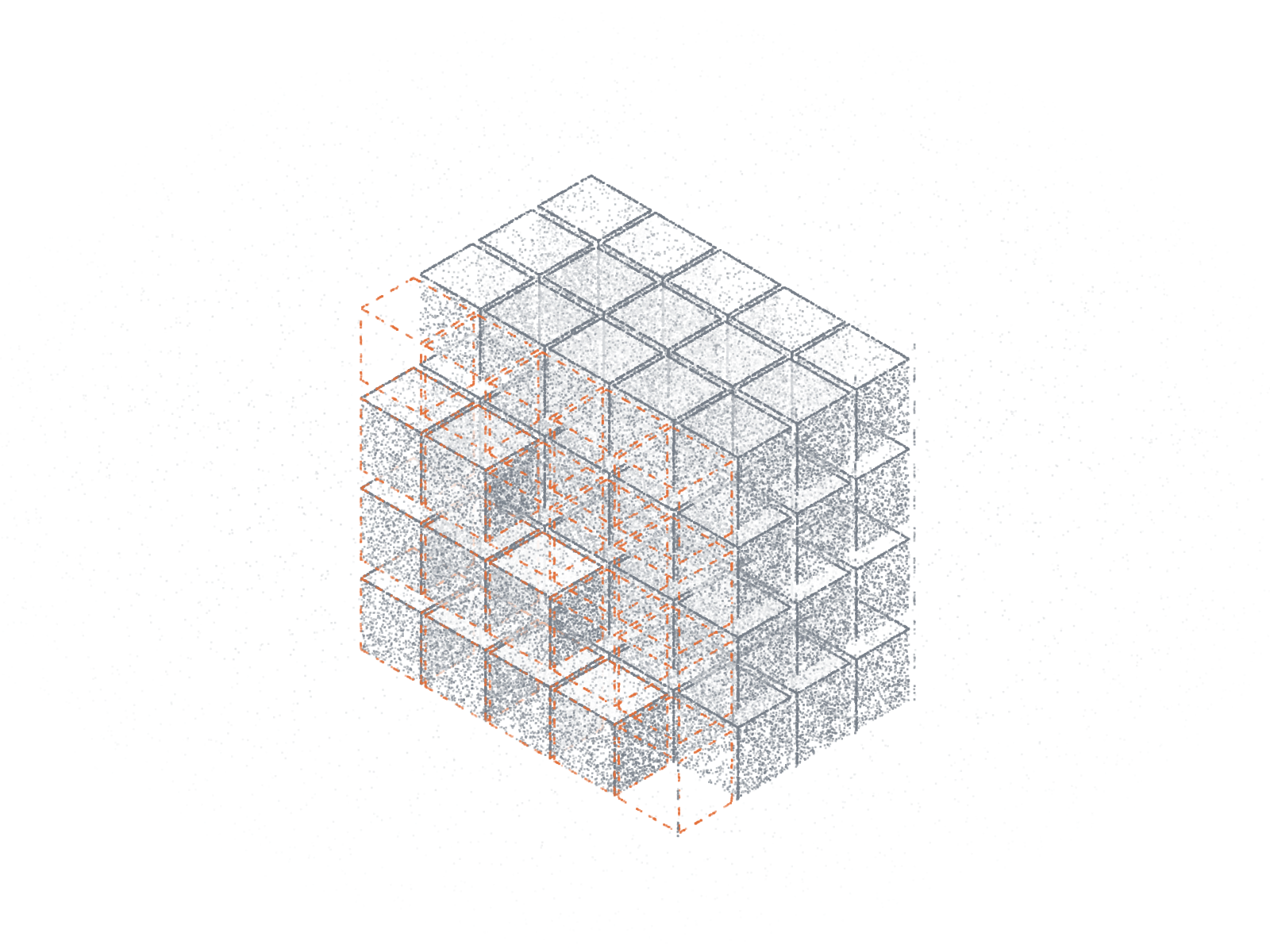
Drive-in vs push-back vs pallet shuttle: which deep-lane rack holds the most
In a 60 × 50 m freezer with 12 m of clear height, where products have about 50 pallets each, a pallet shuttle 26 deep holds 8,115 pallets, push-back racking 5 deep 7,434 and drive-in racking 6,180, at its best depth of only 4. Drive-in also needs about 5 forklifts at the busy hour where the other two need 2. All three put pallets one behind the other in lanes; what they hold depends on how many pallets each product has, and drive-in pays for one detail the drawings do not show: a forklift drives into its lanes, so a whole bay belongs to one product. Below about 50 pallets per product, mobile racking holds more than any of the three. Every figure here comes from the Cold store layout tool.
Three ways to put pallets behind pallets
Drive-in racking
12 pallets move first: the truck drives into the lane, so all levels in front of it go.
Push-back racking
2 pallets move first, on this level only; the rest roll forward on carts.
Pallet shuttle
4 pallets move first. The shuttle (dark) carries them inside the lane; the forklift stays at the face.
- Drive-in. The forklift drives into the lane with the pallet raised and sets it down at the deepest free place; it loads and unloads from the same aisle, so the lane is last in, first out.Mecalux, drive-in and drive-through racking (maker’s page): “each lane stores a single SKU”, “ideal for warehouses with few SKUs and many pallets”. Bartholdi and Hackman add two costs: each pallet rests only on its edges, so pallets must be strong, and the driver needs more skill to work inside the lane.
- Push-back. Pallets sit on nested carts. A new pallet pushes the others back; when the front one is taken, the rest roll forward. Loading and unloading are from the same face, so it is last in, first out, but every lane at every level can be reached on its own. Bartholdi and Hackman describe it as 3 to 5 deep; Dexion sells carts up to 6 deep and lists cold stores among their uses.
- Pallet shuttle. The forklift sets a battery shuttle into a lane and never enters the rack; the shuttle carries each pallet along the lane. Mecalux says its lanes “can exceed 60 m in depth” and its shuttles work down to −30 °C; AR Racking says there is no depth limit set by the vehicle alone.
Why a drive-in lane stays short
Rack lanes waste space as they empty. A lane holds one product; as its pallets leave, the free places wait until the last one goes, because nothing else can go behind it. That is honeycombing, and in a lane k pallets deep it costs (k − 1)/2 places on average.
In push-back and shuttle lanes the unit is one lane at one level. In drive-in it is the whole bay: the forklift drives in at floor level, under the pallets above, and to avoid moving pallets twice every level of the lane holds the same product. Bartholdi and Hackman put it directly: “all the levels of each lane must be devoted to a single SKU.”John J. Bartholdi III and Steven T. Hackman, Warehouse & Distribution Science, release 0.98, § 5.1, p. 39. This freezer has 5 levels, so a drive-in bay 4 deep is 20 places for one product, and by the same rule it stands 9.5 places short of full on average while it empties. A bay 6 deep is 30 places.
So drive-in’s best lane is short. At 50 pallets per product:
| Lane depth | 2 | 3 | 4 | 5 | 6 | 7 | 8 | 9 | 10 |
|---|---|---|---|---|---|---|---|---|---|
| Places | 5,580 | 6,840 | 7,600 | 7,750 | 7,440 | 7,980 | 7,440 | 8,370 | 7,600 |
| Pallets held | 5,070 | 5,879 | 6,180 | 5,965 | 5,425 | 5,520 | 4,889 | 5,234 | 4,529 |
Every lane deeper than 4 holds fewer pallets than 4 deep does. (Places rise and fall from depth to depth because whole rows have to fit the room.)
Push-back and shuttle tie until the lane gets deep
At the same depth, push-back and a shuttle take the same places and hold the same pallets: at 4 deep both have 7,600 places and hold 7,368 here. The difference is how deep each can go. The tool tries push-back from 2 to 5 deep, and 5 is best at 50 pallets per product; Dexion’s 6-deep carts would not help in this room, where 6 deep holds 7,061. The shuttle’s lanes can be as deep as the stock allows: here 26 deep, 10,660 places, 8,115 pallets.
Pallets per product decide
| Pallets per product | Drive‑in | Push‑back | Pallet shuttle | Mobile |
|---|---|---|---|---|
| 20 | 4,654 3 deep | 7,009 4 deep | 7,009 4 deep | 8,100 3 moving aisles |
| 50 | 6,180 4 deep | 7,434 5 deep | 8,115 26 deep | 8,100 3 moving aisles |
| 100 | 6,872 4 deep | 7,593 5 deep | 9,326 26 deep | 8,100 3 moving aisles |
Drive-in holds the fewest of the three at every stock in the table. With few pallets per product push-back and the shuttle tie at 4 deep; as products get bigger the shuttle goes deeper and pulls ahead, by 23% more than push-back at 100 pallets per product. Deep lanes also hide pallets: at 50 per product 30% of drive-in’s pallets can be taken without moving another, 21% of push-back’s and 5% of the shuttle’s. Open this freezer in the tool or with 100 pallets per product.
Forklifts and the busy hour
The tool counts 10 pallet moves an hour for a forklift in drive-in, against 22 in push-back and 25 at the face of a shuttle lane, where the shuttle does the travel inside; then it keeps 75% of each hour for the freezer, where drivers warm up for 30 minutes after 90 in the cold. The drive-in figure is an assumption: no rack maker’s page opened for this post gives one, and no standard was found. At 400 moves a day that is about 5 forklifts working at the busy hour for drive-in, 2.3 for push-back and 2 for the shuttle, plus 3 shuttle vehicles. Dexion gives its shuttles a working range of 8 to 10 hours, 6 in cold stores.
At 1,250 moves a day the gap widens: drive-in needs about 16 forklifts, push-back 7 and the shuttle 6. Mobile racking cannot keep up on its own at that rate (busy stores).
Cost per pallet held: the room, not the rack
Drive-in is the cheapest steel: the tool’s default prices per place are €90 for drive-in, €200 for shuttle racking plus €30,000 a vehicle, and €300 for push-back, each with 20% for installation. But the insulated, refrigerated room is paid per square metre whatever stands in it: at €2,000 per m² this one is €6 million of the €7 million to €8.9 million each layout costs. So cost per pallet follows pallets held more than the price of the steel. At 50 pallets per product:
| Investment per pallet held | Drive‑in | Push‑back | Pallet shuttle | Mobile |
|---|---|---|---|---|
| 50 pallets per product | €1,140 | €1,201 | €1,077 | €1,057 |
| 100 pallets per product | €1,025 | €1,175 | €937 | €1,057 |
Rack prices per place were found only as vendor ranges that contradict each other; the tool’s defaults are editable and could be half or one and a half times these. The shuttle vehicle has no public price at all. Read the row as an order of size, and check it with your own quotes in the tool.
Low rooms: where drive-in catches up
Fewer levels make a drive-in bay smaller, so its lanes can be deeper. With 2 levels (a 6 m room) and 100 pallets per product, drive-in 9 deep holds 3,060 against push-back’s 3,037, and costs €2,152 per pallet against €2,387. At 8 m it holds less than push-back at 100 pallets per product (4,369 against 4,556) and more at 200: 4,693 against 4,603. The shuttle stays ahead in both: 3,730 and 5,993.
Date order: LIFO lanes, drive-through and two-sided shuttles
All three racks above are last in, first out per lane. For deep storage that keeps first in, first out, a second aisle at the far end is needed: in drive-through racking pallets go in at one end and leave from the other, a shuttle works FIFO with two working aisles, and pallet flow lanes roll the pallets from the loading aisle to the picking aisle.Mecalux, drive-in/drive-through and Pallet Shuttle pages (maker’s pages); Bartholdi and Hackman, p. 39. The tool models pallet flow, not drive-through or a two-sided shuttle: at 50 pallets per product flow 10 deep holds 6,905, 15% fewer than the one-sided shuttle.
Bartholdi and Hackman’s caveat applies to deep lanes that are not loaded at one end and emptied at the other: FIFO “can be guaranteed only to within the lane depth”.Bartholdi and Hackman, § 6.4, pp. 69–70. A LIFO lane does not age stock when it holds one lot, because every pallet in it shares a date; the lanes can then be emptied oldest first. Products that must leave strictly by expiry date belong where the oldest pallet is always reachable, in open racks or flow lanes; what that costs is in Cold storage racking.
When mobile racking beats all three
Mobile racking closes aisles instead of putting pallets behind pallets, and every pallet faces an aisle once its aisle opens. Here it holds 8,100 with 3 moving aisles at every stock: more than any deep lane at 20 pallets per product (8,100 against 7,009), level with the shuttle at 50; at 100 the shuttle holds 15% more. With an uneven stock and products of middling size, the tool finds that a split holds more than either alone: mobile racking for the many small products, deep lanes for the few big ones (Storage density vs selectivity). And where every pallet must be reachable all day, selective racking is still the baseline.
Where it breaks
- Moves an hour are assumptions. No source was found for drive-in’s 10 an hour; the others are estimates scaled from a selective reach-truck rate derived from VDI 2198 data sheets. They set the forklifts, and at high throughput the winner.
- Prices are ±50%. Rack prices are vendor ranges, the shuttle vehicle is unpriced, the room is €2,000 per m² by default. All are inputs in the tool.
- The stock spread is assumed. The biggest 20% of products hold 70% of the pallets here; a real stock list is the fix.
- Not modelled: drive-through racking, a shuttle with an aisle at each end, push-back deeper than 5, rack damage from forklifts in drive-in lanes, and safety. One rectangular room on an average day, no columns or docks; rack suppliers check structure, fire rules and floor load.
Sources
- Bartholdi, J. J. and Hackman, S. T., Warehouse & Distribution Science, release 0.98, § 5.1 (rack types, p. 39), § 6.1.2 (lane depth and honeycombing, pp. 54–58), § 6.4 (FIFO, pp. 69–70). PDF
- Mecalux, drive-in and drive-through racking and Pallet Shuttle (maker’s pages).
- Dexion, cart push-back trolleys and pallet shuttle system (maker’s pages).
- AR Racking, pallet shuttle (maker’s page).
- BG BAU, Arbeiten bei Kälte, Infoblatt 4/2022, citing DIN 33403-5 (work time in the cold). PDF
- Layouts, pallets held, forklifts and costs: the Cold store layout engine.
A planning explanation, not a rack design. The numbers are the tool’s model of one example room; rack suppliers check structure, fire rules and floor load. Maker figures are from the makers’ own pages.