Euro pallet dimensions: 1,200 × 800 × 144 mm, and the 7 mm most pages leave out
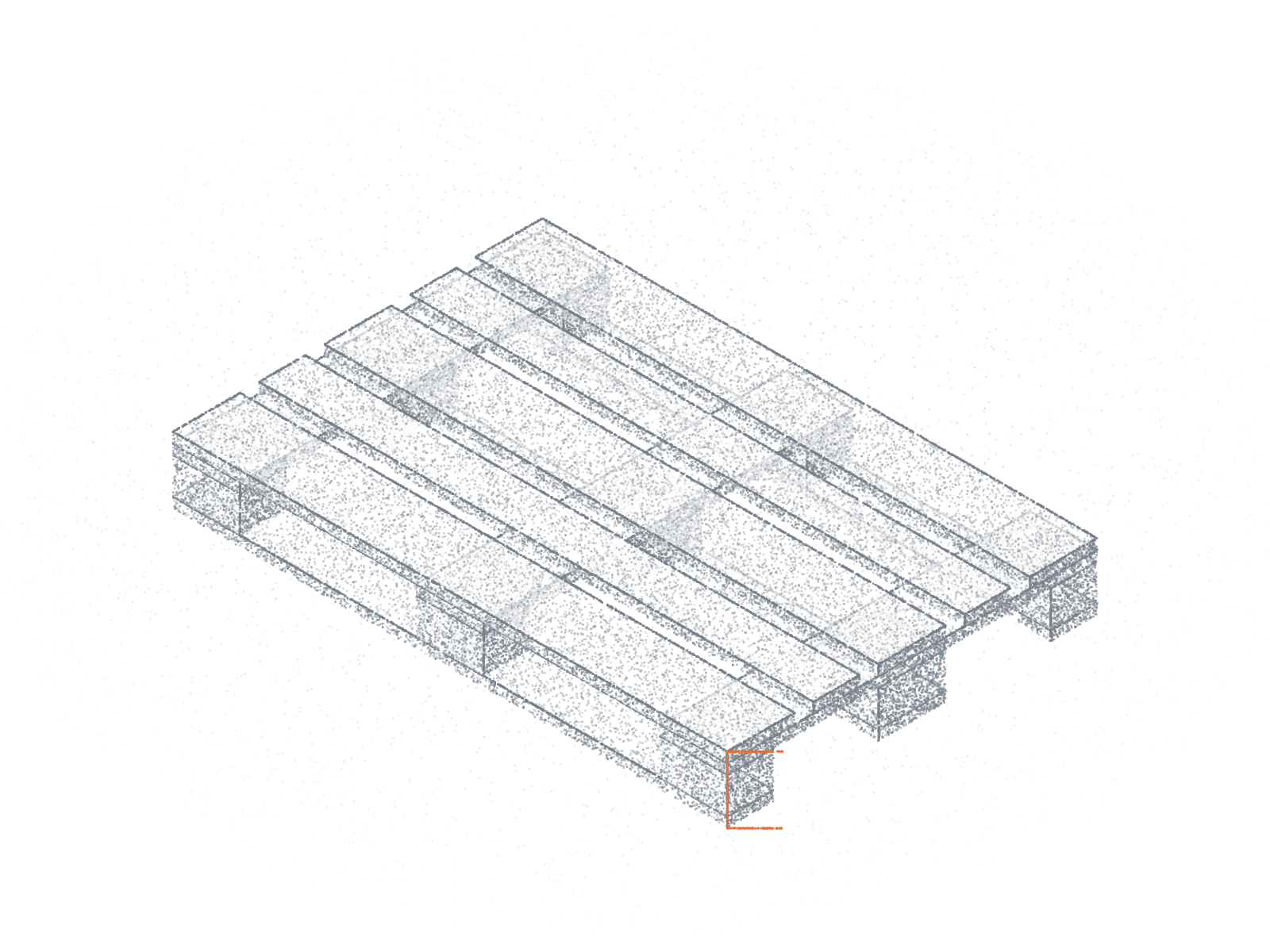
Euro pallet dimensions: a Euro pallet (EPAL 1) is 1,200 × 800 mm on plan and 144 mm high, or 47.2 × 31.5 × 5.7 in. EPAL allows ±3 mm on length and width and up to 7 mm more height, and gives it approx. 25 kg and a safe working load of 1,500 kg. Forks enter from all four sides, through openings 100 mm high on EPAL’s drawing.
1,200 × 800 × 144 mm is the nominal size. The tolerances are on page 2 of EPAL’s own product sheet, and they change how much room is left at the trailer wall, in a rack bay and under a height cap.
The drawing: every dimension EPAL publishes
EPAL draws the pallet from its 1,200 mm side, its 800 mm side and from above. Each dimension below is one EPAL draws; parts the sheet gives no size for are drawn to its proportions without a dimension line.
1,200 mm side
800 mm side
Top view
| Measurement | Nominal, mm | Tolerance | Inches |
|---|---|---|---|
| Long side | 1,200 | ±3 mm | 47.24 |
| Short side | 800 | ±3 mm | 31.50 |
| Height | 144 | +7 / −0 mm | 5.67 |
| Fork entry, 1,200 mm side, as drawn | 100 | +5 / −0 mm | 3.94 |
| Fork entry, 800 mm side, as drawn | 100 | +5 mm / +4 mm, −0 mm | 3.94 |
| Corner block, 800 mm side | 100 | ±3 mm | 3.94 |
| Centre board and block, 800 mm side | 145 | ±3 mm | 5.71 |
| Corner block, 1,200 mm side | 145 | ±3 mm | 5.71 |
| Corner chamfer of the top deck, at 45° | 17 | +4 / −2 mm | 0.67 |
| Span: last two top boards and their gap (800 mm side) | 287 | ±3 mm | 11.30 |
| Span: centre block, one entry, corner block (800 mm side) | max. 477 | — | 18.78 |
| Span: middle block, one entry, end block (1,200 mm side) | max. 677 | — | 26.65 |
The three spans are dimensions on EPAL’s drawing; the sheet doesn’t say what each one is for.
Board thickness isn’t on the drawing but on EPAL’s UK page: boards 22 to 24 mm, stringer boards up to 25 mm.EPAL UK, EPAL Euro pallet, under “Deck boards/stringers/bottom boards”: “EPAL Euro pallet boards must have a thickness of between 22 and 24 mm (stringers up to 25 mm)”. The pallet has 11 boards, 9 blocks and 78 nails (product sheet, page 1). The 100 mm fork entries are read from the drawing: EPAL draws the line across the opening but doesn’t name it.
Why EPAL writes 800 × 1,200
EPAL’s ±3 mm is tighter than ISO’s +3 / −6
ISO 6780 allows +3 / −6 mm on the plan size of every pallet it lists.ISO 6780:2003, Flat pallets for intercontinental materials handling, § 4.1.3 and Table 1 (public preview). EPAL keeps the same upper limit and allows only 3 mm under. The height may only grow:
| Size, mm | Long side | Short side | Height |
|---|---|---|---|
| Nominal | 1,200 | 800 | 144 |
| Largest EPAL allows | 1,203 | 803 | 151 |
| Smallest EPAL allows | 1,197 | 797 | 144 |
| ISO 6780 range | 1,194–1,203 | 794–803 | — |
What the tolerances mean in practice
How much room the largest pallet EPAL allows still leaves, with the numbers from the site’s tools:
| Where | At 1,203 × 803 × 151 mm | More |
|---|---|---|
| Standard trailer, 13.6 × 2.48 m inside | 33 still fit (3 across, 11 rows): 71 mm spare across, 367 mm along | How many Euro pallets fit on a trailer |
| Selective rack bay of 2,700 mm, 75 mm gaps | 3 pallets take 2,709 mm: the four 75 mm gaps (300 mm) lose 9 mm | Selective pallet racking |
| Height cap of 1.80 m including the pallet | 1,649 mm left for the load, not 1,656 | Maximum pallet height |
The trailer row uses the tool’s 2.48 m inside width; a narrower trailer leaves less. The bay row is the 2,700 mm bay from Selective pallet racking, served by a truck with a mast camera; it is arithmetic, not a ruling on rack clearances.
Fork openings and blocks
EPAL draws the entries 100 mm high, +5 / −0 mm on the 1,200 mm side; on the 800 mm side the sheet prints “+5 mm / +4 mm, −0 mm”: two plus tolerances, which the sheet doesn’t explain. ISO 6780 sets these clearances for comparison:
- Pallet trucks: at least 100 mm under the top deck for a high-profile pallet (95 mm standard, 89 mm low profile).
- Fork-lift trucks: at least 50 mm, and 55 mm in some European countries.
- Automatic handling: 100 mm recommended.ISO 6780:2003, Flat pallets for intercontinental materials handling, § 4.2 and Table 3.
EPAL dimensions a corner block in each side view: 100 mm on the 800 mm side and 145 mm on the 1,200 mm side, plus the 145 mm centre board and block. It also gives two maximum spans, each covering a centre block, one fork entry and a corner block: 477 mm on the short side and 677 mm on the long side.
Weight and loads
| Figure | EPAL | Condition |
|---|---|---|
| Weight | approx. 25 kg | |
| Safe working load | 1,500 kg | |
| Bottom pallet of a stack | up to 5,500 kg | laden pallets on a solid, even surface |
Several pages give 4,000 kg as a stacking or static load; EPAL publishes no 4,000 kg figure. Cartons per pallet and per truck are in Euro vs standard pallet; to lay out your own cartons, open Pallet build with the Euro pallet loaded.
Where it breaks
- Not every size is published. EPAL’s public sheet gives no separate width for each board and no block height. The construction standard for the pallet, EN 13698-1, is sold, not free, and wasn’t read.
- Timber moves. ISO 6780 says the dimensions of sawn timber pallets should be tied to a specified moisture content. EPAL’s sheet doesn’t state one.
- Used pallets drift. For exchange, EPAL accepts twisted blocks that stand out up to 10 mm.EPAL UK, EPAL Euro pallet, exchange criteria: “Twisted blocks must not protrude more than 10 mm.”
- A pallet of the same size isn’t an EPAL pallet. These figures are EPAL’s, for pallets with its marks.
- The practice rows are arithmetic. They show how much room is left, not whether a carrier or rack maker accepts it.
Sources
- EPAL, EPAL Euro pallet 800 × 1,200 mm, product sheet PB 05/2025 EN, pages 1–2 (PDF): dimensions and tolerances, weight, loads, parts. Read 2026-11-13.
- EPAL UK, EPAL Euro pallet: board thickness, exchange criteria. Read 2026-11-13.
- ISO 6780:2003, Flat pallets for intercontinental materials handling: §§ 3.2, 4.1.3, 4.2, Tables 1 and 3 (preview).
- Trailer, rack and height figures: the Pallet build, Trailer fit and Cold store engines.
Keep reading
More on warehousing & operations
Topics: Warehousing & operations, Freight markets