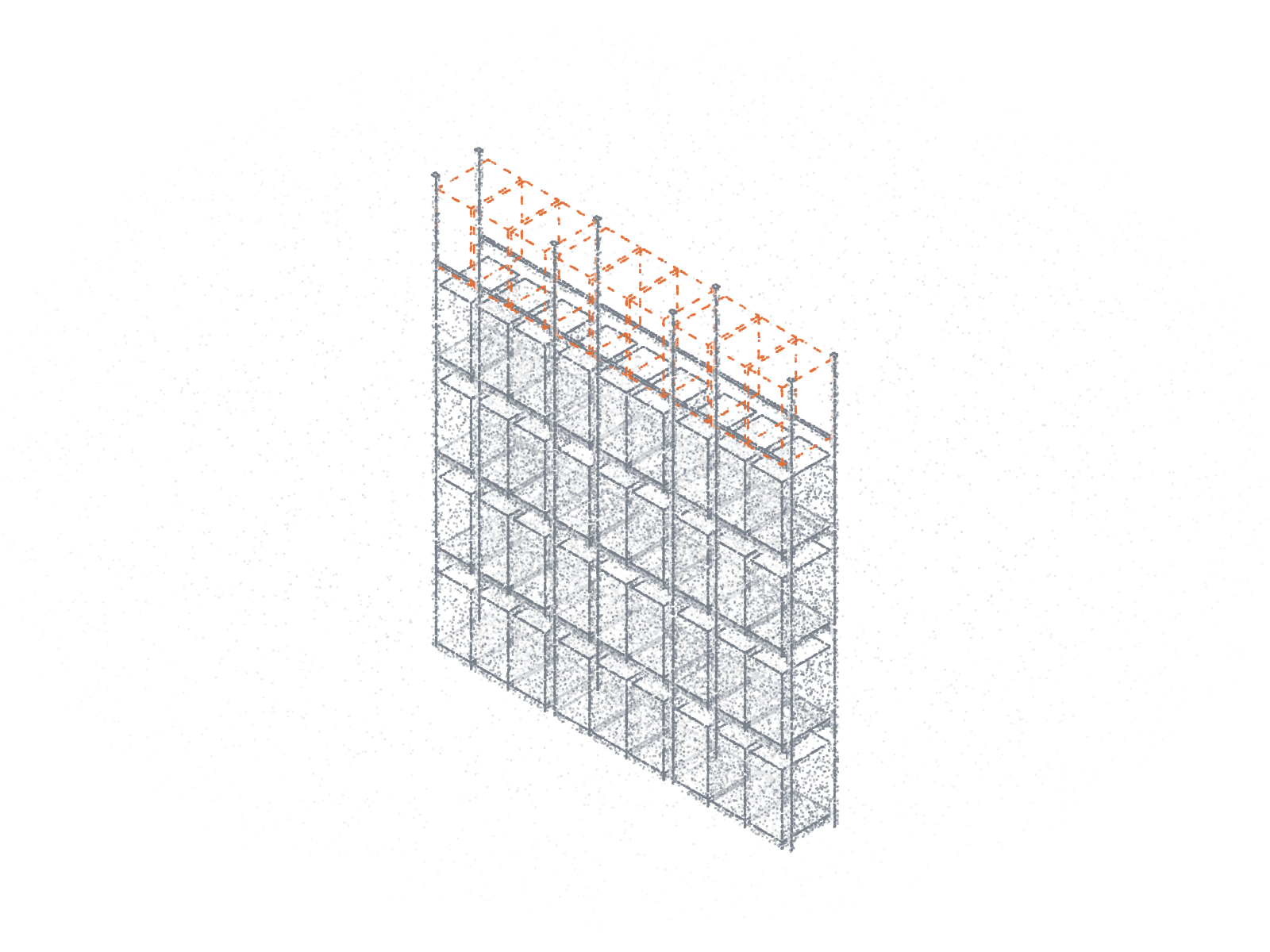
Selective pallet racking: the beams hold 3 tonnes a level, the frame may not hold four
Selective pallet racking is the rack where every pallet can be taken out without moving another, and its sizes follow from the pallet: a bay for three Euro pallets is 2.7 m wide. What it carries is less obvious. In one maker’s tables a 2,700 mm beam pair takes 3,000 kg, so three 1,000 kg pallets a level; the P95 frame under 4 beam levels takes about 9,250 kg, so the pallets on the beams may weigh about 770 kg each, not 1,000.
What selective racking is
Rows one pallet deep, single or back to back in pairs, with a forklift aisle in front of every row: “Each pallet storage position can be accessed individually”.HSE, Warehousing and storage: a guide to health and safety, HSG76, 2nd edition 2007, Table 9. More in What is selective racking? and Storage density vs selectivity.
The bay: 2.7 m from three pallets and four gaps
Three Euro pallets go in side by side on their 800 mm side, with four gaps of 75 mm, the minimum in UK rack makers’ guidance:SEMA (Storage Equipment Manufacturers’ Association) column, Warehouse & Logistics News, 8 Dec 2013: “The minimum clearance between pallets, and pallets and uprights is 75mm”. SEMA, 10 Dec 2014: “3 x 800 wide euro pallets … would give you 2700mm”. EN 15620, the European standard for these clearances (§ 6.4.2), is not public; its 2021 edition dropped the old class system for racks served by industrial trucks.
| What | Euro, 1200 × 800 | 1200 × 1000 |
|---|---|---|
| Pallets per bay | 3 | 2 |
| Clear between uprights | 3 × 800 + 4 × 75 = 2,700 mm | 2 × 1,000 + 3 × 75 = 2,225 mm |
| Bay pitch, with a 100 mm upright | 2,800 mm | 2,325 mm |
| Pallets per metre of rack | 1.07 | 0.86 |
Makers sell beams by this clear width: “Clear bay width 2,700 mm” in one maker’s catalogue, and 1,825, 2,700 and 3,600 mm as the standard lengths for Euro pallets on another maker’s product page.SSI Schaefer, pallet racking catalogue 2025/2026, chapter C; Mecalux, Pallet racking, product page. SSI lists uprights 75, 90, 100 and 120 mm wide. On the same length of rack, Euro pallets put 25% more pallets on the beams than 1200 × 1000 pallets, because the 800 mm side lets three share a bay.
The gaps grow with height. SEMA’s 2013 column keeps 75 mm up to a 9 m beam height and asks for 100 mm from there; its 2014 column asks for 100 mm above 6 m. A man-up truck, a camera on the mast or (2014) automatic height selection lets the 75 mm stay. With 100 mm gaps, three Euro pallets need a 2,800 mm clear bay. The example below has its top beam at 7.86 m, so under the 2014 column it would need that width unless the truck has one of those aids.
The frame: 1.1 m for a 1.2 m pallet
The pallet’s 1,200 mm side goes into the rack, and the frame (the two uprights and their bracing) is shorter than that:
- Frame depth: 1,200 − 2 × 50 = 1,100 mm. The pallet stands 50 mm over the beam at the front and at the back, as SEMA recommends; two makers give the same 1,100 mm frame for a 1,200 mm pallet.SEMA, 8 Dec 2013: “SEMA recommends a 50mm pallet overhang at the front and back of the rack”. Mecalux: “For a Euro-pallet measuring 1,200 mm deep, the frame will normally be 1,100 mm.” SSI Schaefer: storage depth 1,200 mm, rack depth 1,100 mm.
- Back to back: two frames with 200 mm between them, the tool’s figure, make a double rack 2,400 mm deep.
- Between the pallets of the two rows that leaves 200 − 2 × 50 = 100 mm, the least one maker allows: “a safety distance of at least 100 mm between the pallets in double-sided racks”.SSI Schaefer catalogue 2025/2026, § 1.3. Fire flues are outside this post.
What a level holds and what the frame holds
At 12 m clear height the rack gets 5 levels of 1.964 m, the first on the floor, so 4 on beams (how the levels are counted). Every beam level hangs on the frame; the floor level stands on the slab. Here is what one maker’s published tables give for a 2,700 mm bay:
| Part | One maker’s rating | What it means here |
|---|---|---|
| Beam pair CE 110/40 | 3,000 kg per level | 3 pallets of 1,000 kg |
| 4 full beam levels | 12,000 kg on the frame | 12 pallets of 1,000 kg |
| Frame P73 | 5,350 kg | 1 full level, or 440 kg per beam pallet on 4 levels |
| Frame P93 | 7,550 kg | 2 full levels, or 620 kg per beam pallet |
| Frame P95 | 9,250 kg | 3 full levels, or 770 kg per beam pallet |
So in this example the beams are not the limit; the frame is. Each beam pair could take three 1,000 kg pallets, but the strongest of the three standard frames in that table carries only 3 such levels.SSI Schaefer catalogue 2025/2026, chapter C, evenly distributed loads, to DIN EN 15512:2020. Beam pairs for a 2,700 mm bay: CE 80/40 1,500 kg, CE 110/40 3,000 kg, INP 100 3,500 kg. Frame load (“The permissible frame load (or bay load) depends on the compartment height”): values at 1,750 and 2,000 mm compartment height, the lower taken for this 1.964 m pitch: P73 6,550 / 5,350 kg, P93 7,850 / 7,550 kg, P95 9,250 / 9,450 kg. Valid for at least two beam pairs per bay and five bays per line. The maker’s kit table counts bay loads the same way: 5 levels of 1,000 kg pallets, 12,000 kg. A beam pair’s rating says nothing about how many of them the frame can take.
The frame’s rating depends on how far apart the beams are: in the same table the P73 frame takes 9,100 kg at 750 mm between beams and 5,000 kg at 2,500 mm. The catalogue lists frames up to 30,000 kg and others on request, so a heavier frame can be bought. The point is to ask for both numbers.
SEMA adds that there is “no specific legislation that requires a load sign”, but the employer must give staff the information needed to use the racking safely.SEMA technical FAQ, sema.org.uk.
When the rack must be emptied
The UK guidance sets how often racks are checked and what each level of damage means:HSG76 ¶ 645–646 and Table 11. SEMA, “Get smart with rack inspections”, 28 Jun 2021, says the same in its own words. EN 15635 is the European standard for using and maintaining racks; it is not quoted here.
- Visual checks by the warehouse “weekly or other regular intervals based on risk assessment”.
- An expert inspection at “intervals of not more than 12 months”.
- Green: “surveillance only”: safe to use, recorded and looked at again at later inspections.
- Amber: the bay is not loaded again until it is repaired, and it is “redesignated red risk if remedial work has not been carried out within four weeks”.
- Red: the rack is “immediately offloaded and isolated” until it is repaired.
Try it
The Cold store tool with a 30 × 12 × 12 m room suggests its own mix of rack types first; under “Compare the layouts”, its “Selective only” row shows 540 (4 rack faces × 9 bays × 3 pallets × 5 levels). It counts positions, not weights: a frame that cannot take every level leaves fewer usable levels at full beam load than it reports. Positions per m² by forklift and room height are in Warehouse capacity calculation.
Where it breaks
- Clearances are UK makers’ association guidance; the European standard’s values are not public, and SEMA’s own columns put the step from 75 to 100 mm at 9 m (2013) or 6 m (2014).
- The tool keeps 75 mm beside every pallet and 100 mm above every load at any height. For racks with beams above 6–9 m it slightly overstates the positions per metre of rack; the top beam in the 12 m example is at 7.86 m.
- Load tables are one maker’s, for evenly spread loads, at least two beam pairs per bay and five bays per line. Other makers’ frames and beams have their own ratings; above 2,500 mm between beams that maker asks for its own calculation.
- Other pallets and countries: 1200 × 1000 and US 48 × 40 in pallets, and US practice (RMI), have their own sizes and rules; this post does not cover them.
- Prices per position are not given: no primary source we opened publishes them.
- This is not a rack design or an inspection. Ask the maker for the bay’s beam and frame ratings at your beam heights, and have the rack inspected.
Sources
- HSE, Warehousing and storage: a guide to health and safety, HSG76, 2nd edition 2007: Table 9, ¶ 633–634, ¶ 645–646, Table 11.
- SEMA columns on rack clearances, Warehouse & Logistics News, 8 Dec 2013 and 10 Dec 2014. SEMA technical FAQ. SEMA, “Get smart with rack inspections”, 28 Jun 2021.
- SSI Schaefer, pallet racking systems catalogue 2025/2026, chapter C (beam and frame load tables, § 1.3). Mecalux, Pallet racking product page.
- EN 15620:2021, scope and contents (preview). EPAL, Euro pallet (EPAL 1).
- All dimensions: the Cold store tool’s rack engine, Euro pallets with 1.6 m of load.
Keep reading
More on warehousing & operations
Topics: Warehousing & operations