Loading meters, and why your invoice says a different number
Ten Euro pallets are 4.0 loading meters. Every calculator agrees, because it is one line of arithmetic: 10 × 1.2 × 0.8 ÷ 2.4. Ship those pallets with a groupage carrier and the invoice will not say 4.0 of anything. It will say a weight, between 6,600 kg and 8,000 kg depending on the carrier, for pallets that weigh 3,000 kg. This post is about the gap between the formula and the invoice, with three consignments run through seven published carrier rule sets and the generic 2.4 m convention. The numbers come from the Trailer fit tool, which applies the same rules.
The formula and where it comes from
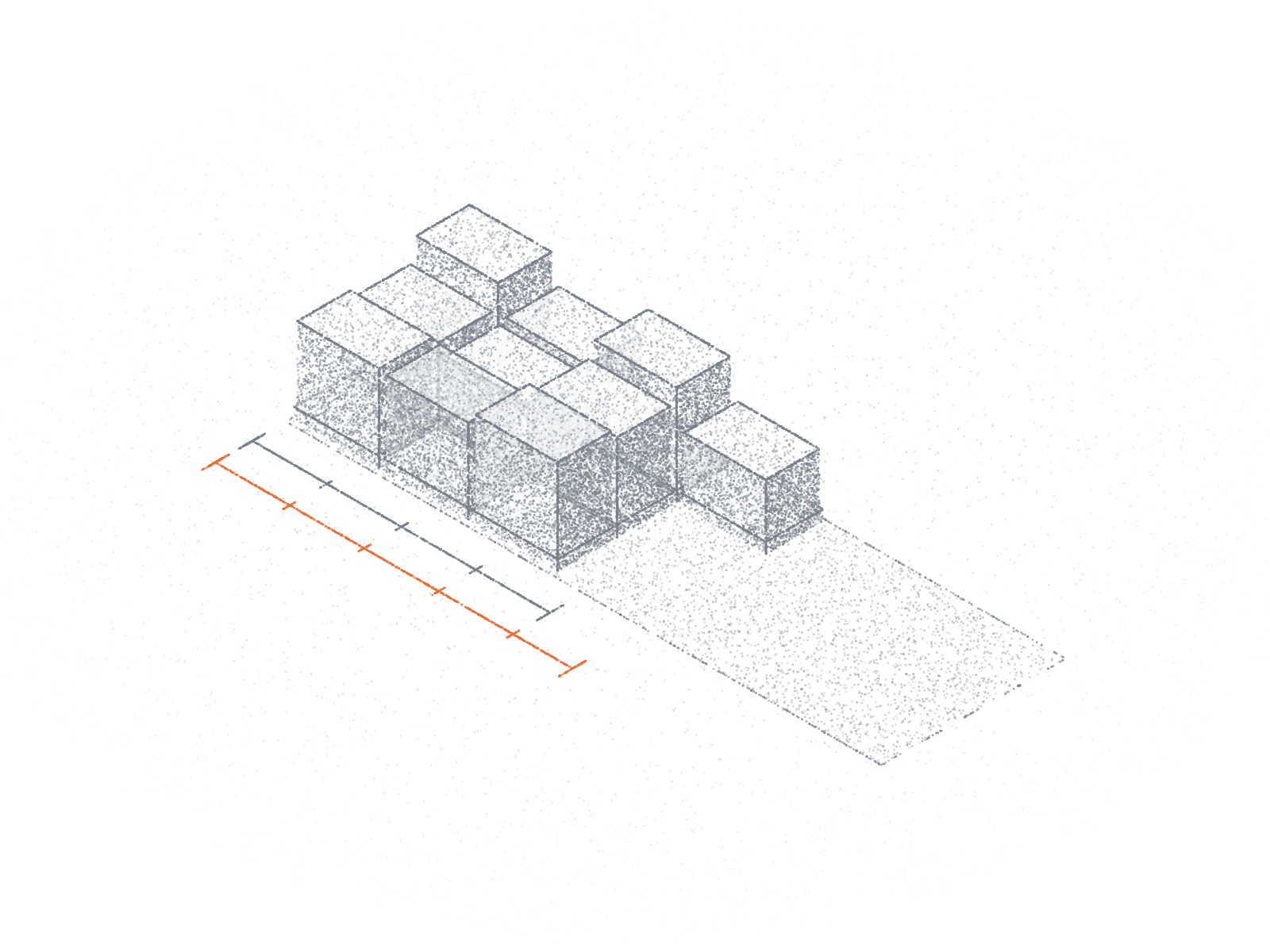
A loading meter (LDM, Lademeter, laadmeter) is one metre of trailer length, at full width. The full width is taken as 2.4 m, not because trailers are 2.4 m wide (they measure about 2.45 to 2.48 m inside) but because pallets are: three Euro pallets on their short edge, or two on their long edge, are exactly 2.4 m.DB Schenker’s Belgian terms describe their standard trailer as “13.6 m long, 2.4 m wide, 2.4 m high”. DHL Norway defines one loading meter as 100 × 250 × 260 cm. Same convention, written two ways. So a unit’s loading meters are its footprint divided by 2.4 m²: a Euro pallet is 0.96 ÷ 2.4 = 0.4, an industrial pallet 1.2 ÷ 2.4 = 0.5, a half pallet 0.2.
That is the geometric number. It describes floor. Carriers charge for the floor you take away from other customers, so when a shipment cannot be stacked under or over, the loading meters are converted to a weight with a factor, and the invoice uses the higher of that weight and the real one.
The factor is not a constant
The factor is the first place the invoices diverge. These are the published values, read on 24 October 2026:
| Carrier rule | kg per loading meter | kg per m³ | Stackable only up to |
|---|---|---|---|
| DHL Freight Slovakia | 1,650 | 250 | 200 cm (100 cm if declared non-stackable) |
| DHL Freight Netherlands, Eurapid | 1,750 | 330 | 120 cm |
| DSV Italy, international | 1,800 | 333 | 120 cm |
| DB Schenker Belgium | 1,850 | 333 | 120 cm |
| Posti Freight, Finland | 1,850 | 333 | 130 cm |
| DHL Freight Norway, Continental | 1,850 | 333 | 160 cm |
| DHL Freight Norway, Nordics | 2,000 | 333 | 160 cm |
The second place is the stacking rule. Each carrier draws a line at a height; below it a pallet counts as stackable and is charged by volume (cubic metres times the kg per m³ factor), above it the pallet is charged by floor. The line sits at 100, 120, 130, 160 or 200 cm. The third place is what a stackable pallet is charged by at all: by volume at most carriers, by half its floor at DB Schenker when there are three or more, and counted in pairs at DHL Netherlands.
Consignment 1: ten pallets you cannot stack
Ten Euro pallets, 120 cm high, 300 kg each, marked non-stackable. Four loading meters by the formula and four metres of floor as loaded (two rows of three, then two rows of two turned).
Everyone charges this by floor, so the only difference is the factor: 6,600 kg at DHL Slovakia, 7,000 kg at DHL Netherlands, 7,400 kg at Posti and DB Schenker, 8,000 kg in the Nordics. Against 3,000 kg of real weight, you are paying for 2.7 times what the scale says. That is the price of a pallet nobody can put anything on.
Consignment 2: the same pallets, 20 cm lower and stackable
Take the same ten pallets at 100 cm, packed so that others can go on top. Nothing changes on the floor, and in most rulebooks the charge drops to volume: 9.6 m³ at 330 to 333 kg is about 3,197 kg, close to the real 3,000 kg. At DHL Slovakia volume gives 2,400 kg and the real weight wins instead.
Two carriers stand out. DB Schenker charges three or more stackable pallets at half their floor, so 2.0 loading meters × 1,850 = 3,700 kg. And Posti charges any shipment over 2,500 kg by pallet meters regardless of stacking, so these 3,000 kg of stackable pallets are billed at 7,400 kg, the same as if they were not stackable at all.Posti’s page has worded this rule two ways: shipments over 2,500 kg are always based on pallet meters, and, in the current English text, items weighing more than 2,500 kg. The tool applies it to the whole consignment; if your consignment is heavy but made of light pallets, ask Posti which reading your contract uses. Same ten pallets, 3,000 kg to 7,400 kg.
Consignment 3: one crate
A machine crate, 220 × 120 × 150 cm, 900 kg, not stackable. By the formula it is 1.1 loading meters; on the floor it takes a 1.2 m slice across the trailer, because 220 cm fits across the 248 cm width and nothing fits beside it.
Every carrier charges it by floor, from 1,815 kg to 2,200 kg. The crate weighs 900 kg; the invoice weight is roughly double. For a single heavy, awkward unit the difference between carriers is a few hundred kilograms, which is a few percent of the bill. For ten light pallets it was a factor of two.
What to do with this
- Measure height including the pallet, and know the carrier’s line. The cheapest consignment to ship is the one that sits under it and is honestly stackable.
- Read the kg-per-loading-meter factor before comparing quotes per loading meter. 1,650 and 2,000 are the same unit with a 21% difference built in.
- Check the shipment-level rules. A 2,500 kg threshold (Posti) or a half-floor rule for three or more pallets (DB Schenker) changes the answer for whole consignments, not single pallets.
- Check the invoice against the booking. A line billed by floor for pallets booked as stackable and under the line is a rule error you can prove; How freight audit works walks through one.
- Count the floor, not only the formula. The formula gives 0.4 for a lone Euro pallet; a loader sees a 1.2 m row with two empty places. When your goods are the odd shape, the floor is what you will be asked to pay for.
The tool does the arithmetic for a mixed consignment and shows the eight rules side by side. The rules are published conventions read on the date shown; contracts differ, and the carrier’s current tariff governs.
The rules above were read from each carrier’s published document on 24 October 2026 and summarised for planning. They are not quotes, carriers change them, and your contract governs; confirm figures with your carrier before relying on them. Carrier names identify the documents only; this post and the tool are independent of every carrier. Full notice on the tool page.
Keep reading
Linked from
More on freight markets
Topics: Freight markets, Warehousing & operations