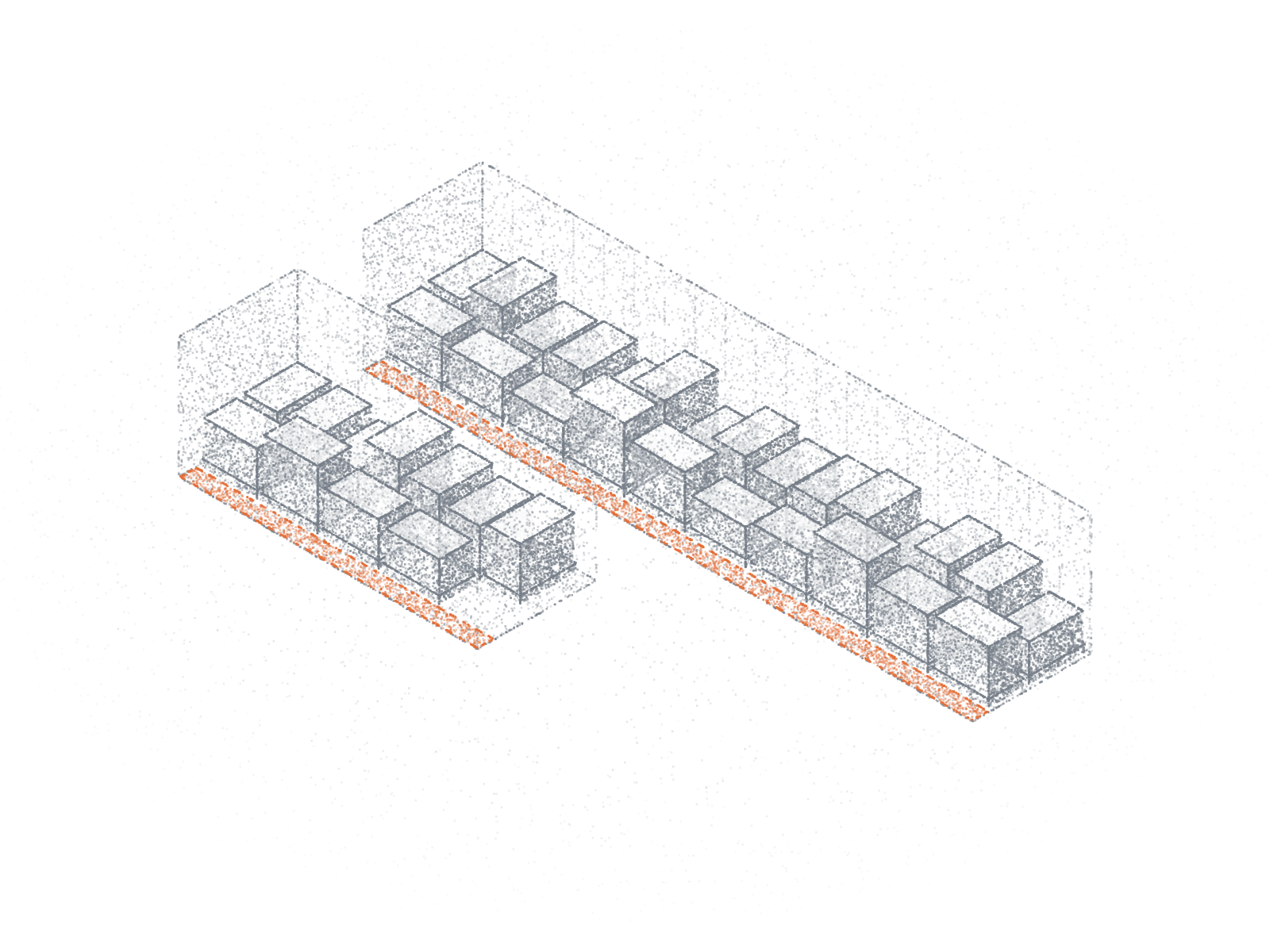
How many pallets fit in a 20 ft or 40 ft container? 11 and 25, then the road decides
A 20 ft container takes 11 Euro pallets or 9 industrial pallets on its floor. A 40 ft container takes 25 Euro or 22 industrial on paper, but the 25 leave only 3 cm of spare length, so 24 is the safer number to plan with. A high cube has the same floor. The weight runs out before the floor does: on an EU road at 40 t, after the tractor, the chassis and the empty box, a 40 ft carries about 24 t of cargo and a 20 ft about 25.4 t. So a full floor of 25 Euro pallets is only legal on the road if they average 958 kg or less. This post goes through the floor, the gaps, the door and the weight, with the numbers from the Trailer fit tool.
The answer in one table
Inside sizes from a container lessor’s spec sheets for new boxes; pallet counts from the tool, one layer, no stacking.Triton International lease spec sheets for the 20 ft, 40 ft, 40 ft high cube, 40 ft high cube reefer and 45 ft pallet-wide, read 7 November 2026. Boxes from other makers and years differ by a few centimetres and in their weight ratings.
| Container | Inside L × W (m) | Euro pallets | Industrial pallets | Door height |
|---|---|---|---|---|
| 20 ft container | 5.89 × 2.35 | 11 | 9 | 228 cm |
| 40 ft container | 12.03 × 2.35 | 25 | 22 | 228 cm |
| 40 ft high cube | 12.03 × 2.35 | 25 | 22 | 258 cm |
| 40 ft high cube reefer | 11.58 × 2.29 | 23 | 20 | 256 cm |
| 45 ft pallet-wide | 13.55 × 2.44 | 33 | 26 | 263 cm |
| 13.6 m trailer, for comparison | 13.60 × 2.48 | 33 (34 turned) | 26 |
The counts are less round than on a trailer because an ISO container is about 2.35 m wide inside, not 2.45 to 2.48 m. Three Euro pallets across need 2.40 m, so they don’t fit. Instead the tool loads two lanes: one with the pallets turned across (80 cm each along the box) and one with them lengthwise (120 cm each). An industrial pallet (120 × 100 cm, one of the standard pallet sizes) does the same with 100 and 120 cm.
Why 25 becomes 24: the 3 cm
In a 40 ft box the lane across holds 15 Euro pallets (15 × 80 = 1,200 cm) and the lengthwise lane holds 10 (10 × 120 = 1,200 cm). The box is 1,203 cm long inside. Both lanes have 3 cm to spare, which is nothing: stretch wrap, a carton that sticks out (pallet overhang) or a pallet set down a little crooked uses it up. Each lane then loses a pallet:
| Pallet as loaded | Euro pallets in a 40 ft |
|---|---|
| 120 × 80 cm, exactly | 25 |
| 121 × 80 cm | 24 |
| 120 × 81 cm | 24 |
| 121 × 81 cm | 23 |
That is why sellers and forwarders quote 23, 24 or 25 for the same box: all three are right, for pallets of slightly different sizes. Industrial pallets have the same problem, 12 × 100 and 10 × 120 cm, both 1,200 cm: 22 exact, and 20 at 121 × 101 cm. The 20 ft is safer: its lane across uses 560 of 589 cm, so 11 still fit with up to 4 cm of overhang or wrap on every pallet.
The 35 cm along the wall
Two lanes of Euro pallets are 80 + 120 = 200 cm wide. The box is 235 cm, so 35 cm stay empty along one wall, the whole length of the container. Pallets left loose like that can slide sideways at sea or on the road. The CTU Code, the industry’s code of practice for packing containers, prefers palletised cargo stowed “from boundary to boundary” and adds that firm stowage alone may not be enough.IMO/ILO/UNECE Code of Practice for Packing of Cargo Transport Units (CTU Code, 2014), 7.2.2. It is guidance, not law. In practice the gap gets filled or braced: dunnage bags, timber, or the pallets split into two groups against each wall.
A road trailer is 2.45 to 2.48 m wide inside and takes three Euro pallets across. A container is about 10 cm narrower, and the 35 cm is what those 10 cm cost. It is also why the loading meter does not apply here: a full container is booked as a box, not by the metre of floor.
High cube, reefer and the 45 ft pallet-wide
- 40 ft high cube: the same floor, 2.69 m high inside instead of 2.39 m. The same 25 Euro or 22 industrial pallets; the extra 30 cm only helps with stacking.
- 40 ft high cube reefer: the insulated walls and the cooling unit take 45 cm of length and 6 cm of width, leaving 11.58 × 2.29 m. That is 23 Euro or 20 industrial pallets.
- 45 ft pallet-wide: 2.44 m inside, wide enough for three Euro pallets across. Eleven rows make 33, the same as a trailer in the usual layout: a trailer’s load that can also go by rail or short-sea ship. EU rules allow the extra length for a truck carrying one on the road leg of an intermodal journey.Directive (EU) 2015/719, amending 96/53/EC: 15 cm of extra length for vehicles carrying 45 ft containers in intermodal transport.
Stacking: the door, not the roof
A standard box is 2.39 m high inside, so two pallets fit under the roof if each is at most 119 cm, pallet included. But the door opening is only 228 cm high. A stacked pair taller than that will not go in as one, and stacking inside the box needs room to lift the top pallet over the bottom one, which two pallets of 119 cm under a 239 cm roof do not leave. The tool warns about it:
2 high is 238 cm, above the 228 cm door, so the stack will not go in as one. Stacking inside needs room to lift the top pallet under the roof.
So the working limit for pairs is the door: 228 cm, less a few centimetres to lift them, which is pallets of about 110 cm each. In a high cube the roof allows two of 134 cm and the door pairs up to 258 cm, so pallets of about 125 cm. Stacking also needs goods that can bear a pallet on top, and it doubles the weight on the same floor, which brings back the next limit.
The road limit, not the box limit
A new 40 ft box is rated for 29 t of cargo, and 20 ft for 28.4 t. Those are the box’s limits, set on the CSC safety plate on the door. On the road the box sits on a chassis behind a tractor, and the whole vehicle must stay within 40 t in the EU:Directive 96/53/EC, Annex I, 2.2.2. As amended by Directive (EU) 2015/719: 42 t for a two-axle tractor and 44 t for a three-axle tractor, with a three-axle semi-trailer carrying containers up to 45 ft in intermodal transport, 2.2.2(c) and (d). National limits differ.
| On the road | 20 ft | 40 ft |
|---|---|---|
| Road limit | 40 t | 40 t |
| Tractor | about 8 t | about 8 t |
| Container chassis | about 4.5 t | about 4.5 t |
| Empty box | 2.1 t | 3.5 t |
| Cargo left | 25.4 t | 24 t |
| Box rating, for comparison | 28.4 t | 29 t |
20 ft container
The box is rated for 28.4 t; the dashed 3 t is legal at sea, not on a 40 t truck.
40 ft container
The box is rated for 29 t; the dashed 5 t is legal at sea, not on a 40 t truck.
- Tractor, about 8 t
- Chassis, about 4.5 t
- Empty box
- Cargo at 40 t
- Rated, over 40 t
The tractor’s weight is a range, about 7.5 to 8.7 t for common 4×2 tractors, and the chassis figure is one maker’s 40 ft box liner (4,520 kg).Krone Box Liner eLTU40-2 data sheet. Tractor weights from dealer listings; weigh your own. Your own vehicles move the answer by a tonne either way, but not the conclusion:
-
A 40 ft is bought for volume, not weight. At 40 t it carries about 24 t, so a full floor of 25 Euro pallets works only up to 958 kg each (25 at 958 kg). Pallets of a tonne fit the box and not the road. The tool says so:
25,000 kg fits the box, but is more than a 40 t truck can take on EU roads: about 24,000 kg of cargo after tractor, chassis and the empty box. About 28,000 kg on the road leg of rail or sea transport (44 t).
-
Heavy goods go in a 20 ft. It carries about 25.4 t on the road, 2,309 kg for each of its 11 places: 11 pallets of 2 t raise no warning. This is the reason behind the shipping habit of putting heavy goods in 20 ft boxes.
-
Where the weight sits matters. The CTU Code asks for the cargo’s centre of gravity within ±5% of the box’s middle, as a rule of thumb 60% of the cargo’s mass in half its length, and terminals check it when they lift the box. Container floors are built for the payload spread evenly, so two-tonne pallets need spreading, or beams under them.CTU Code, Annex 7, 3.1.4; Annex 2 (terminal checks); 6.2.4 on wall and floor strength.
Before a box goes on a ship, the shipper must declare its verified gross mass, by weighing it packed or by weighing the cargo and packing and adding the tare. Without it, the box is not loaded.SOLAS chapter VI, regulation 2, in force since 1 July 2016; UK guidance on gov.uk. That rule checks the box against the ship. It does not check the truck.
Where this breaks
- Boxes differ. The sizes and ratings here are new lease boxes. Older boxes are often rated lower; the CSC plate on the door and the tare painted beside it are the real figures for yours.
- The road sum is a planning figure. 8 t and 4.5 t are typical; weigh your tractor and chassis. Some countries allow more than 40 t domestically, and crossing a border with it is not automatic.
- The law is being revised. A revision of Directive 96/53/EC has been in negotiation since December 2025, mostly about zero-emission and intermodal trucks. The figures here are the Directive in force on 7 November 2026.
- Wood outside the EU. Wooden pallets going to most countries outside the EU must be heat treated and stamped under ISPM 15. New EPAL Euro pallets are; check the stamp on repaired and non-EPAL pallets.
- Other pallets fit differently. Inch pallets (48 × 40 in), 120 × 120 cm pallets and overhanging loads change the lanes; the tool takes any size under Custom.
- The tool counts and weighs. It does not plan securing, axle loads, the centre of gravity or lifting room.
How the same pallets fit a road trailer, with its own weight limit: How many Euro pallets fit on a trailer?
Sources
- Triton International, lease spec sheets: 20 ft dry, 40 ft dry, 40 ft high cube, 40 ft high cube reefer, 45 ft pallet-wide. Read 2026-11-07.
- IMO/ILO/UNECE, Code of Practice for Packing of Cargo Transport Units (CTU Code, 2014): 6.2, 7.2.2, Annex 2, Annex 7 3.1.4. PDF via Hapag-Lloyd.
- Directive 96/53/EC, Annex I (weights and dimensions). EUR-Lex CELEX 01996L0053; readable copy at legislation.gov.uk. Amended by Directive (EU) 2015/719.
- Revision 2023/0265(COD): Council general approach, 4 Dec 2025; state of negotiations: TrasportoEuropa, 2 Nov 2026.
- Krone, Box Liner eLTU40-2 data sheet (chassis tare).
- GOV.UK, Verified gross mass of containers.
- EPAL, EPAL Euro pallet (ISPM 15 treatment since 2010).
- Pallet counts, road weights and warnings: the Trailer fit engine, sizes on the tool page.
A planning explanation, not loading advice. Counts are geometric and weights are planning figures; the box’s CSC plate, the vehicle’s papers, the carrier and national rules govern. Full notice on the tool page.
Keep reading
Linked from
More on freight markets
Topics: Freight markets, Warehousing & operations