How freight audit works, and the invoice line it can't settle
A freight audit compares every line of a carrier’s invoice with the contract and the shipment record, ideally before the invoice is paid. On 6 stackable Euro pallets, a carrier that charges by floor instead of by volume turns 2,206 kg of chargeable weight into 4,200 kg, 90% more, and an audit can prove it from the booking. If the depot measured the same pallets at 122 cm instead of 115, 4,200 kg is correct, and nothing on the invoice says which height is true. Tools such as nShift Audit and Loop check every invoice line against contract rates automatically; the 122 cm case still needs evidence from the loading dock, whoever does the check.
What a freight audit checks
US federal agencies must audit freight bills before paying them, and GSA’s handbook lists what a person checks:31 U.S.C. § 3726(a)(1). The implementing rules, 41 CFR part 102-118, define a prepayment audit as checking “validity, propriety, and conformity of rates with tariffs, quotations, agreements, contracts, or tenders”.
- origin, destination and mileage
- the rate, freight class and fuel surcharge
- accessorials charged, and “Accurate weight used”
- total billed against total charged
- the papers: delivery receipt, bill of lading, weight tickets, and that the shipment “has not been previously paid”
In European road freight it can be a matching job against the forwarder’s tariff. Puma, for example, stores its forwarders’ rates by country and postcode and matches each invoice against them: about eight to ten invoices a week, some 600 shipments.Logistik Heute, 1 November 2025, and CIO.de, 20 November 2025, both based on a release by the transport-software vendor LIS (WinSped). Neither gives a savings figure.
How much an audit finds is less clear. The only figure we found that is not from a vendor’s marketing: in fiscal year 2011, US federal prepayment auditors reported overcharges of 3.4% of the bills they checked ($3.8 million of $114.2 million).GSA OIG report A120060/Q/9/P13001, 14 March 2013, Table II: 3,846,770 of 114,216,991 dollars, five contract auditors. The auditors reported the figures; the OIG compiled them. “Savings” there means overcharges identified, not money recovered, and one auditor handled relocations, not only freight. Vendor figures (5–15% error rates, 1–5% of spend) are mostly unsourced; this post uses none of them.
One consignment, four invoices
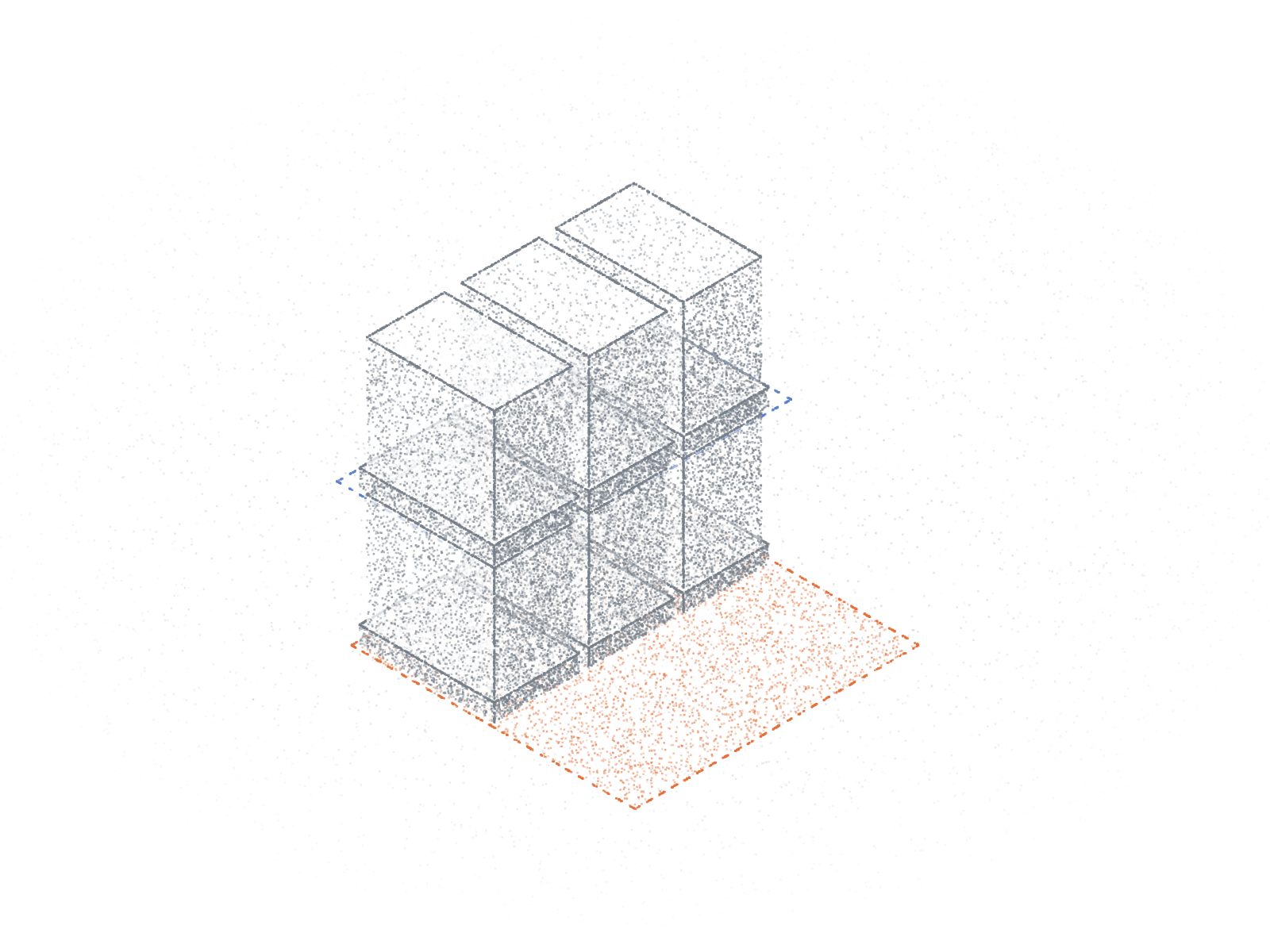
The consignment: 6 Euro pallets, 115 cm high including the pallet, 250 kg each, booked as stackable, 1,500 kg on the scale. The contract is a generic rule, not any one carrier’s: 1,750 kg per loading meter, 333 kg per m³, stackable up to 120 cm. The invoice bills the chargeable weight, the higher of the real weight and the weight the rule gives the space.
| Invoice | What the carrier applied | Chargeable weight | Against the contract |
|---|---|---|---|
| A | Stackable, under 120 cm: by volume, 6.62 m³ × 333 | 2,206 kg | correct |
| B | Charged as not stackable: by floor, 2.4 loading meters × 1,750 | 4,200 kg | +1,994 kg (+90%) |
| C | As B, at 1,850 kg per loading meter | 4,440 kg | +2,234 kg (+101%) |
| D | Measured at 122 cm at the depot: over the line, by floor | 4,200 kg | correct, if 122 cm is right |
B and C are rule errors, provable from the booking and the contract. The basis is the big one: 90%, against 5.7% for the wrong factor on top (why the basis swings so much).
D is right by the rule if the pallets really were 122 cm, and the invoice line shows the weight, not the height. Software can flag the jump from the booking; it cannot say whether film and a top sheet added 7 cm. Ask the forwarder for the depot’s measurement record and photos, and keep your own from loading.Open the 115 cm consignment and the 122 cm one in Trailer fit to see the same 6 pallets under seven published carrier rules.
The example is in kilograms on purpose: road tariffs are priced in weight bands per lane, so 90% more chargeable weight is not 90% more money; it can be a band or two.
What the software takes over
The software automates the matching, not the judgement. In outline, the products in this post work roughly the same way:
Two examples, mostly from their own pages: nShift Audit, announced in August 2026 by the shipping-software company nShift (London and Oslo), and Loop, a San Francisco company that “began in freight audit and payment”.
| What | nShift Audit | Loop |
|---|---|---|
| Covers | Parcel and freight, “from per-parcel surcharges to pallet and groupage invoices” | Parcel, truckload and LTL, ocean, air |
| Checks | “Seven checks on every invoice line”, among them weight and volume, price, surcharge; rate cards can follow “loading meters” | Each line “against your contract rates and accessorial terms”; catches “overcharges, duplicate bills, and contract errors” |
| When | Before payment: “dispute and hold payment”, or clear the rest (its recommended flow) | “Before you pay them”; payments that fail a rule are “held for review” |
| Disputes | “Disputes with the evidence attached, ready to send” | An agent “opens a dispute with the carrier”; its Managed Service runs disputes for you |
| Pays the carrier | Its pages describe audit and dispute; payment stays in the shipper’s process | Yes: “three payment models”, early pay “in exchange for a negotiated discount” |
| AI | Reads layouts “with no carrier templates”; the verdicts are “deterministic rules” | “AI-driven data extraction and validation with human oversight”; “always provides the reason why an audit failed” |
| Rate card | Freight Rate Calculation service; Excel, Portal or nShift’s services team | “Dynamic pricing”, “contracted rate” and “spot rate” audits |
| Price | Not published; “scales with the size of your freight operation” | Not published |
Design choices
Before payment or after. Before, there is nothing to claw back. After is the federal rules’ “second line of defense”, usually sold on contingency: the auditor keeps “a percentage of the recovered amount”, capped at 50% for US federal contracts.41 CFR 102-118.135(b); GSA transportation handbook; 31 U.S.C. § 3726(e). Our reading, not either company’s claim: a share of recoveries rewards finding claims afterwards, a subscription rewards preventing them.
Hold the invoice or clear it. Holding keeps leverage; clearing keeps payment terms and the carrier’s goodwill. Where German forwarders’ standard terms apply, check them before holding anything.ADSp 2017, clause 19: set-off or withholding against the forwarder’s claims only if the counterclaim is “fällig, unbestritten, entscheidungsreif oder rechtskräftig festgestellt” (due, undisputed, ready for decision or finally decided). Our reading, not legal advice: that makes it risky to hold the undisputed rest of an invoice, or the next invoice, against a disputed overcharge; contesting the flagged line itself is a different matter.
AI reads, rules decide. Reading invoices in any layout is where the AI is used. A verdict that can be explained to a carrier line by line matters more than how the invoice was read: in nShift’s design the verdict stays a rule, and Loop gives “the reason why an audit failed”. nShift adds that “a person confirms that the first invoice in a new format has been read correctly”.
Deadlines
A valid overcharge is worth nothing once its window closes, which is the strongest argument for checking before payment.
| Where | Rule | Source |
|---|---|---|
| US motor freight | A shipper must contest a bill “within 180 days of receipt of the bill in order to have the right to contest such charges” before the Board | 49 U.S.C. § 13710(a)(3)(B) |
| US motor freight | A civil action to recover overcharges within 18 months after delivery (or tender of delivery) | 49 U.S.C. § 14705(b), (g) |
| International road (CMR) | Claims arising out of the carriage: one year (three for wilful misconduct). For claims other than loss, damage or delay it starts three months after the contract of carriage was made; a written claim suspends it | CMR Art. 32 |
| Germany | Claims from a carriage under the HGB: one year from the end of the day of delivery | HGB § 439 |
Austria’s Supreme Court has held that the CMR year also applies to a sender’s claim to get back overpaid freight.OGH, Rechtssatz RS0074001 (lead decision 1 Ob 337/75): “Auch der Anspruch des Absenders auf Rückgewähr zuviel gezahlter Fracht unterliegt daher der einjährigen Verjährung des Art 32 CMR”. Courts have argued a plain double payment differently. An audit that runs once a quarter on last year’s invoices is racing that clock.
Where it breaks
These limits belong to the method, not to a product.
- No rate card, no price check. Only the checks that need no price can still run.
- Contracts need reading first. “…you also have to interpret the rate card and the contract correctly before you can call a line wrong” (nShift’s live-audit post). Posti’s 2,500 kg rule has been worded two ways on its own page.
- The invoice lacks the physical facts. Invoice D: only evidence from the dock settles it.
- Some lines cannot be read or priced. A careful tool marks them unverified rather than guessing; a person resolves them.
- The data underneath is wrong. “We discovered it was bad data” (Loop’s CEO, on invoice reconciliation in his time at Uber Freight).
- The auditor can be wrong too. In FY2023 GSA made “a voluntary payment of $29.6 million” to a Defense Department vendor “in an effort to resolve ongoing litigation challenging the program’s underlying legal authority”, acknowledging a contracting officer’s decisions that its overcharge notices “were erroneous”.
- Carriers push back. “The carrier might accept the first ten lines and give a reason for rejecting the rest” (the same nShift post).
Questions to ask a vendor
- Which charging rules can you reprice: loading meters, stacking heights, kg per m³ and per loading meter, minimums, diesel and toll surcharges?
- Where does the expected price come from, and who updates the rate card when a tariff changes?
- What happens to a collective invoice, and to a line you cannot read or price?
- Do you check before payment, and does a dispute hold the invoice or run alongside it?
- What evidence goes with a dispute: booked dimensions, the forwarder’s own measurement data, photos?
- Can I see, rule by rule, why a line was flagged?
- How are you paid: a share of recoveries or a subscription?
- How do you track a dispute to closure: is the credit note matched to the disputed line, and does the dispute go to the carrier in writing (under CMR, a written claim suspends the limitation period)?
Companies in this post
| Company | Based | What it does here |
|---|---|---|
| nShift (nShift Audit) | London and Oslo | Shipping software; AI invoice audit for parcel and pallet freight, announced August 2026 |
| Loop | San Francisco | Freight audit and payment for parcel, truckload, LTL, ocean and air |
Checked on 11 November 2026 against: nShift’s product page, why we built it, a live audit and about; Loop’s audit and payment pages, its Series C release and a FreightWaves article of 4 May 2026.
Sources
- 31 U.S.C. § 3726, Payment for transportation, (a)(1) and (e).
- 41 CFR part 102-118, Transportation payment and audit, §§ 102-118.15, 102-118.135.
- GSA, Transportation handbook: freight, household goods and small parcel, invoice payment and audit reference guide (updated 27 March 2026).
- GSA Office of Inspector General, Report A120060/Q/9/P13001 (14 March 2013), Table II.
- GSA, FY 2025 Congressional Justification, Transportation Audits, pp. P-2 to P-5.
- 49 U.S.C. § 13710(a)(3) and 49 U.S.C. § 14705(b), (g).
- UNECE, Convention on the Contract for the International Carriage of Goods by Road (CMR), Art. 32 (archived copy).
- HGB § 439, Verjährung.
- DSLV, Allgemeine Deutsche Spediteurbedingungen 2017 (ADSp 2017, text as of 17 October 2016, copy published by a forwarder), Ziffer 19.
- Oberster Gerichtshof, Rechtssatz RS0074001, Art. 32 CMR.
- Logistik Heute, Puma hat die Prüfung von Frachtrechnungen automatisiert (1 November 2025); CIO.de, Puma automatisiert Kontrolle von Frachtkosten (20 November 2025).
- nShift and Loop pages as listed under Companies in this post, read 11 November 2026.
- Chargeable weights: computed in the post by the Trailer fit tool’s engine under its generic rule.
Not affiliated with any company named. Based on public sources as of 11 November 2026.
A planning explanation, not legal advice. The deadlines quoted are the texts named; your contract and the law that governs it are the ones that apply.
Keep reading
Linked from
More on freight markets
Topics: Freight markets