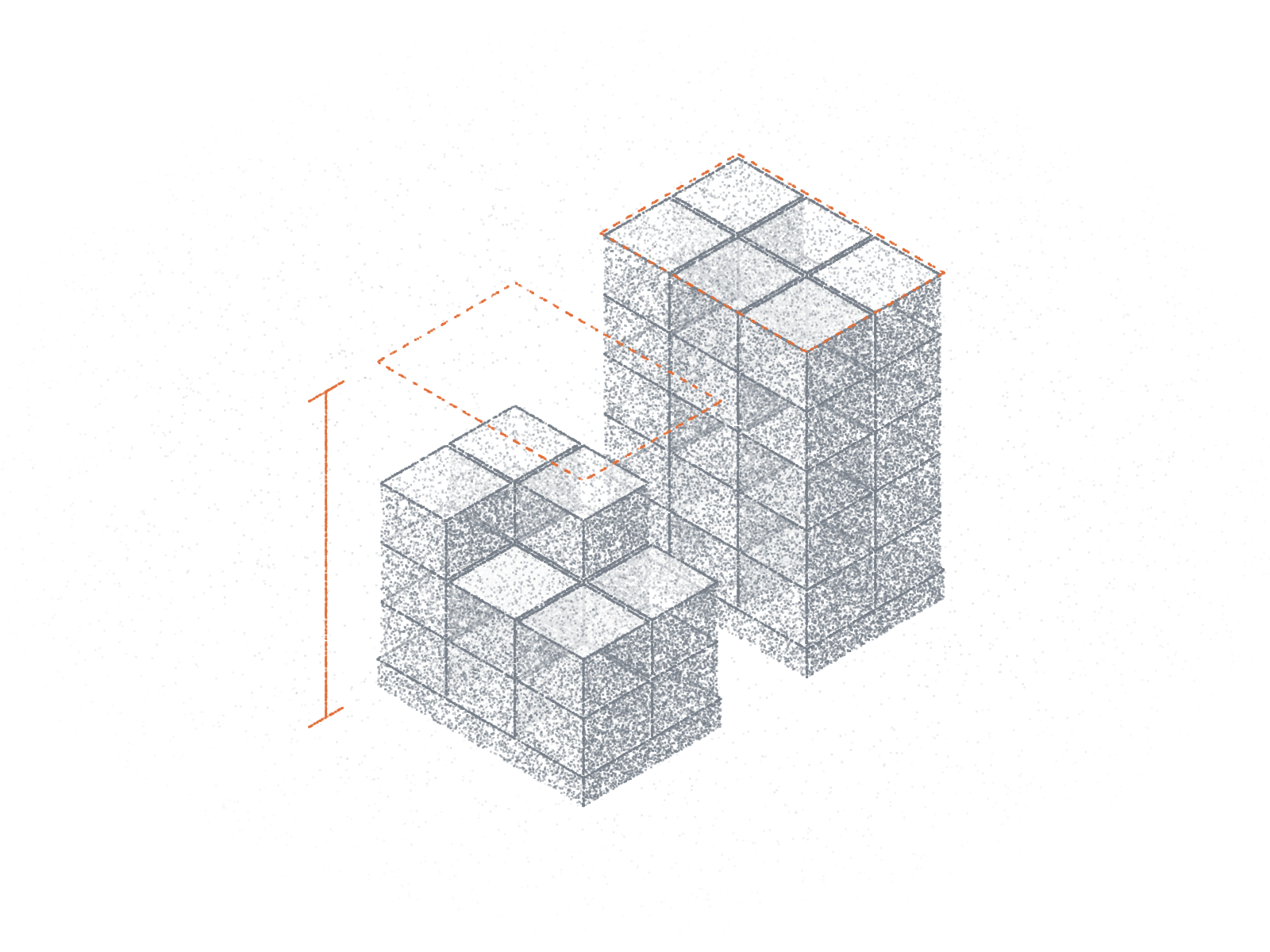
How many pallets will this order make?
The packing list from the factory says 480 cartons of shoes and 120 cartons of boots, with sizes and weights. The forwarder’s form asks for something else: how many pallets, how tall, how heavy. Between the two sits a calculation that everyone does in their head or in a spreadsheet, and that goes wrong in the same four places every time: the layer pattern, the height cap, the pallet’s own weight, and the last pallet. This post walks through it with two packing lists. The numbers come from the Pallet build tool, which does the same arithmetic and draws it.
Cartons per layer is a pattern, not a division
A shoe carton is 40 × 30 × 25 cm. A Euro pallet is 120 × 80 cm. Dividing the areas gives 8 cartons per layer, and that happens to be right, but only because the carton is turned. With the long side along the pallet, ⌊120/40⌋ × ⌊80/30⌋ is 3 × 2 = 6. Turned, ⌊120/30⌋ × ⌊80/40⌋ is 4 × 2 = 8. A mixed row, one column lengthwise and the rest turned, gives 7. The best of them is 8, in turned columns.The tool tries every split along both sides and every pinwheel arrangement, keeps the one with the most cartons, and shows the others under the drawing so you can pick a pattern the warehouse prefers.
The drawing turns every second layer by 180°. On an uneven pattern (a mixed row or a pinwheel) that moves the joints, so cartons bridge the ones below and the stack ties itself together. On a regular grid like this one the turned layer lands on exactly the same footprint, and the columns still line up. Neither is wrong: interlocking is more stable, while aligned columns keep corner over corner and carry far more weight. In Fibre Box Association tests, interlocked stacks lost 49–54% of the boxes’ compression strength against 12–20% for aligned columns.Fibre Box Association, “The Tech Box”, July 2021, and its pallet-pattern study, which interlocked by turning each layer 180°. Heavy or tall stacks favour columns; tall, light, wobbly ones favour interlocking.
The cap includes the pallet
How many layers? Height cap minus pallet, divided by the carton height, rounded down. The cap is where people lose a layer, because it is almost always quoted including the pallet and almost always remembered without it. A Euro pallet deck is 14.4 cm; under a 1.80 m cap that leaves 165.6 cm, so ⌊165.6/25⌋ = 6 layers of shoe cartons, not 7.
Where does 1.80 m come from? Not from a law. It is the carrier’s or the receiving warehouse’s rule, and the lower of the two applies: European pallet networks and groupage carriers take full pallets up to 2.20 m, some retail warehouses only 1.80 m. Where the terms say, the figure includes the pallet.Confirm the figure for the actual lane. Who publishes which limit, with sources: Maximum pallet height for shipping. The chip changes the answer more than any other input. The same shoe order under 1.50 m is 1 layer less per pallet and 22 pallets instead of 18, 22% more pallets to book and 8.8 loading meters instead of 7.2.
Sometimes weight decides, not height
Three limits set the layers and the smallest one wins: the height cap, the weight the pallet may carry, and any cap on layers the goods themselves need. For shoes, height binds by a mile: the weight limit would allow 184 layers. For tiles it is the other way round.
A layer of eight tile cartons weighs 160 kg. The Euro pallet’s safe working load is 1,500 kg, the pallet itself weighs about 25 kg, so ⌊(1,500 − 25) / 160⌋ = 9 layers, a pallet 122 cm tall under a 1.80 m cap. A height-only calculator would say 13 layers and 104 cartons, and the pallet would weigh 2,105 kg. The tool names the limit that bound, because the fix is different in each case: a lower cap means another lane, a weight limit means a stronger pallet or a lower stack.
The pallet weighs something
Every gross weight in the tool is written as goods + pallet, because the pallet’s own weight is the most common reason a scale disagrees with a packing list. EPAL gives approx. 25 kg for the Euro pallet and approx. 35 kg for the 1200 × 1000 industrial pallet. “Approx.” is doing real work: the weight moves with the wood’s moisture, and EPAL publishes no dry or wet figure. The lightweight one-way pallets sold for export in the same footprint weigh less, carry less, and are a different product; if those are what the factory uses, weigh one and edit the figure.Half pallets (EPAL 6) are approx. 9.5 kg. EPAL’s current page gives a safe working load of 750 kg; older EPAL product cards said 500 kg. The tool uses 750. On the shoe order the 18 pallets add 450 kg to 1,440 kg of goods: 1,890 kg on the invoice.
The last pallet is its own pallet
120 boot cartons at 16 per pallet are 7 full pallets and 8 cartons left over. The part pallet is not a rounding error. It has its own layers (2), its own height (84 cm against 154 for a full one) and its own weight (89 kg against 153), and on the truck it behaves differently: a short pallet may fit where a full one does not, and some carriers let a short pallet carry another on top.
That is why the tool hands the part pallet to Trailer fit as a row of its own, with its own height and weight, rather than rounding the line up to 8 identical pallets.
Which face is down
Some cartons have no “this way up”, and then the best footprint is not the base. A flat 60 × 50 × 20 cm panel carton placed on its base fits 2 to a layer on a Euro pallet: 60 along 120 twice, and 50 across 80 once. It stacks 8 layers high, 16 per pallet, 200 cartons make 13 pallets. Stood on its long side the footprint is 60 × 20 and the carton is 50 cm tall: 8 per layer, 3 layers, 24 per pallet, 9 pallets.
Untick “this way up” and the tool tries the two other faces and says which one it chose. Whether the goods allow it is your call, not the geometry’s.
What is not in the tool
Mixed pallets, several carton sizes on one pallet, are not. Whether a mixed pallet works depends on the packing order and on whether the bottom cartons can take the load, and a drawing that ignores both would look authoritative while being wrong. The tool builds one carton size per pallet and gives you the part pallets to combine as you see fit. Crush strength in general, stretch wrapping, load securing and the warehouse’s own rules are also outside it. It arranges rectangles.
Keep reading
More on warehousing & operations
Topics: Warehousing & operations, Freight markets