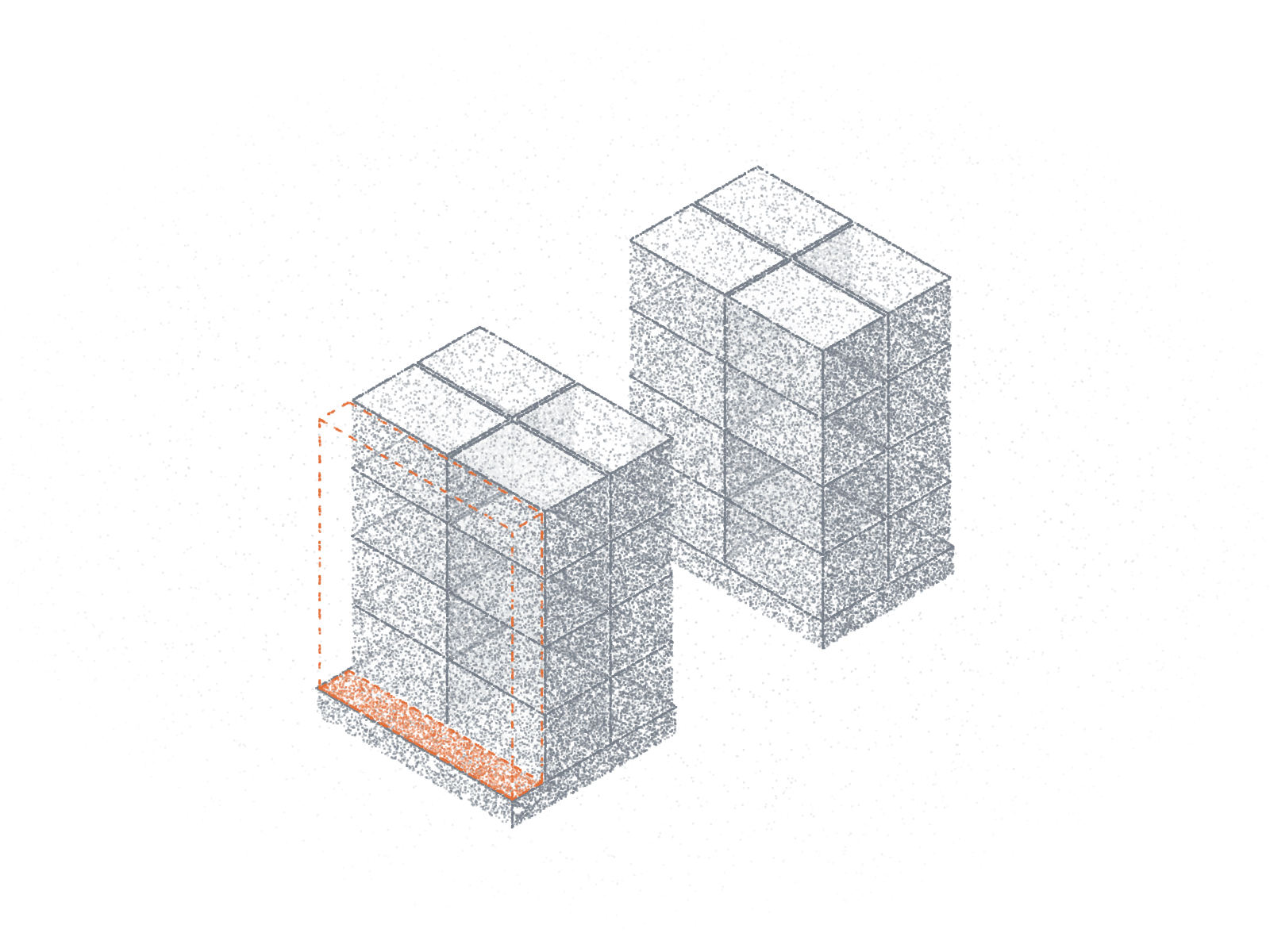
Euro vs standard pallet: which carries more of your cartons?
For cartons sized to the 600 × 400 mm packaging module, the choice barely matters. A 60 × 40 × 40 cm carton goes 4 to a layer on a Euro pallet (1200 × 800 mm) and 5 on a UK or industrial pallet (1200 × 1000 mm). Under a 1.80 m height cap both carry 40 cartons per loading meter, and a full 13.6 m trailer takes 528 on 33 Euro pallets and 520 on 26 UK ones. Cartons off the module break the tie, and in either direction: 30 × 30 cm cartons ride 20% denser on the 1200 × 1000, 40 × 40 cm cartons 25% denser on the Euro pallet. Heavy cartons favour the Euro pallet, which is rated for 1,500 kg against 1,250 kg. The numbers come from the Pallet build and Trailer fit tools.
Per pallet the bigger pallet wins; per metre of truck it usually doesn’t
“Standard pallet” means different things in different places. In the UK it is the 1200 × 1000 mm pallet, which EPAL sells as EPAL 2 and the continent calls the industrial pallet; in North America it is the 48 × 40 in pallet. The six ISO sizes include both. This post compares the 1200 × 1000 with the Euro pallet, and the 48 × 40 in at the end.
The 1200 × 1000 always carries more cartons per pallet, because it is a quarter larger. That only matters when you pay per pallet. Road freight in Europe is priced by floor: a Euro pallet is 0.4 loading meters and a 1200 × 1000 pallet 0.5, and a full trailer is a full trailer whichever pallet is on it. So the fair comparison is cartons per loading metre, and cartons per full trailer, where 33 Euro pallets use 13.2 m and 26 UK pallets 13.0 m.
Why module cartons tie: the 600 × 400 grid
Packaging sizes follow a module. ISO 3394 builds carton footprints from 600 × 400 mm (and 600 × 500 mm), so that cartons fill the standard pallets without gaps.ISO 3394:2012 bases its package dimensions on the plan modules 600 × 400, 600 × 500 and 550 × 366 mm, for the pallet series of ISO 3676. Abstract read via AFNOR. A Euro pallet is exactly two 600 × 400 modules. A 1200 × 1000 pallet is two and a half: four cartons of 60 × 40 cm cover 1200 × 800 and the fifth goes crosswise in the last 20 cm strip. Both decks are fully covered, so cartons per square metre are equal and cartons per loading meter are equal too. The same holds for the module’s fractions, 40 × 30 and 30 × 20 cm. The layer count, TI, changes; the density does not.
The 600 × 500 module is the 1200 × 1000 pallet’s own. A 60 × 50 cm carton goes 4 to a layer on it and only 2 on a Euro pallet, which leaves 38% of the deck empty: 60% more per loading meter on the 1200 × 1000. “Module carton” is not one size.
The table: eight cartons, two pallets
Each carton this way up, no overhang, under a 1.80 m cap including the pallet:
| Carton, cm | Per pallet, Euro / UK | Per loading meter | Full trailer | More per metre |
|---|---|---|---|---|
| 60 × 40 × 40 the 600 × 400 module | 16 / 20 | 40 / 40 | 528 / 520 | tie |
| 40 × 30 × 25 ¼ module | 48 / 60 | 120 / 120 | 1,584 / 1,560 | tie |
| 30 × 20 × 20 ⅛ module | 128 / 160 | 320 / 320 | 4,224 / 4,160 | tie |
| 60 × 50 × 40 the 600 × 500 module | 8 / 16 | 20 / 32 | 264 / 416 | UK +60% |
| 50 × 40 × 30 off module | 20 / 30 | 50 / 60 | 660 / 780 | UK +20% |
| 30 × 30 × 30 off module | 40 / 60 | 100 / 120 | 1,320 / 1,560 | UK +20% |
| 40 × 40 × 40 off module | 24 / 24 | 60 / 48 | 792 / 624 | Euro +25% |
| 35 × 25 × 25 off module | 60 / 72 | 150 / 144 | 1,980 / 1,872 | Euro +4% |
The off-module cartons go one way or the other depending on how they fill each deck. Thirty-centimetre cubes fill 75% of a Euro deck and 90% of a 1200 × 1000 deck, so the bigger pallet carries 20% more per metre. Forty-centimetre cubes fill the Euro deck exactly, six of them, and the 1200 × 1000 also takes only six, with a fifth of its deck empty.
A lower cap changes the counts but not the winners: under 1.50 m, every carton in the table keeps the same winner.
The deck height can cost a layer. The 1200 × 1000 pallet’s deck is 16.2 cm high, the Euro pallet’s 14.4 cm. For a module carton 15 cm tall, 20 × 15 × 15 cm, that is 11 layers under 1.80 m on the Euro pallet and 10 on the 1200 × 1000, so 880 against 800 cartons per loading meter. Check the layer count as well as the layer.
Weight: the “heavy-duty” pallet is rated lower
EPAL rates the Euro pallet for 1,500 kg and the 1200 × 1000 (EPAL 2) for 1,250 kg.Safe working loads for a loaded pallet on a flat floor, from EPAL’s product pages. A pallet at the bottom of a stack may carry up to 5,500 kg (Euro) and 4,250 kg (EPAL 2). Per loading meter that is 3,750 kg against 2,500 kg. Light cartons never notice. Dense ones do: a 40 × 30 × 25 cm carton fills both pallets to the cap at 1 kg, and at 22 kg the 1200 × 1000 stops at 5 layers while the Euro pallet still takes 6. Per loading meter that is 120 against 100.
Tiles show it more clearly: 40 × 30 × 12 cm cartons at 20 kg go 72 to a Euro pallet and 60 to a 1200 × 1000, both stopped by weight, so 180 against 120 per loading meter (the tiles example, worked through). On a full trailer, though, the truck’s payload decides, not the pallet. 33 Euro pallets of tiles would weigh 48,345 kg; with 24,000 kg of payload the trailer takes 16 Euro pallets (1,152 cartons) or 19 UK ones (1,140). The pallet rating matters per pallet: in groupage, pallet networks and racking.
Paying per pallet changes the answer
UK pallet networks charge by the pallet space, in tiers by weight and height, and the space takes at least a 1200 × 1000 pallet.Palletonline lists its tiers up to 1200 × 1000 mm (full pallets to 1200 × 1200 mm); pallet2ship lists quarter, half and full pallets by weight and height. Both are carriers’ own pages, and the tiers differ between networks. A Euro pallet pays the same as a UK pallet there, so per paid pallet the 1200 × 1000 carries 20 module cartons against 16, a quarter more. The same goes for storage billed per pallet place. Where you pay by floor, the table above applies; where you pay per pallet, the bigger pallet wins.
And the 48 × 40 in pallet
The North American pallet, 121.9 × 101.6 cm, is a little larger than the 1200 × 1000. On metric cartons it takes the same layer as the 1200 × 1000 with less than 2 cm to spare, and 26 fit on a European trailer floor. On cartons sized in inches it wins: a 16 × 12 in carton (40.6 × 30.5 cm) goes 9 to a layer on it, 8 on a 1200 × 1000 and 6 on a Euro pallet. Load ratings for 48 × 40 in pallets vary by maker, so check yours.
Where this breaks
- The pricing unit decides. Per loading meter or per trailer, module cartons tie; per pallet space or pallet place, the 1200 × 1000 carries a quarter more for the same fee.
- 33 or 34 Euro pallets. A trailer of a full 13.60 m takes one more Euro pallet with the last two rows turned (how many fit on a trailer), which tips module cartons slightly further toward the Euro pallet.
- Containers are different. A 40 ft container takes 25 Euro pallets or 22 UK ones, so 60 × 40 × 40 cm cartons fit 400 against 440: the tie breaks toward the 1200 × 1000.
- Overhang changes several rows. A centimetre or two over each edge can add a column to an off-module carton, at the cost of carton strength.
- This way up only. Cartons that may lie on a side can fill a deck differently; the tool tries every face when allowed.
- You may not get to choose. The customer, the pallet exchange pool or the racking often decides the pallet before the carton does.
Sources
- EPAL, EPAL Euro pallet (EPAL 1) and EPAL 2 pallet: dimensions, weights, safe working loads. Read 2026-11-07.
- ISO 3394:2012, Packaging: Complete, filled transport packages and unit loads: Dimensions of rigid rectangular packages. ISO; abstract read via AFNOR.
- ISO 6780:2003, Flat pallets for intercontinental materials handling: principal dimensions and tolerances.
- UK pallet network tiers (carriers’ pages): Palletonline, pallet2ship. Read 2026-11-07.
- Cartons per pallet and pallets per trailer: the Pallet build and Trailer fit engines.
A planning explanation. Counts are geometric, for cartons this way up without overhang, given without warranty; carton strength, wrapping and your carrier’s or warehouse’s limits are not considered. Full notice on the tool page.
Keep reading
More on warehousing & operations
Topics: Warehousing & operations, Freight markets