How many Euro pallets fit on a trailer? 33, until weight says no
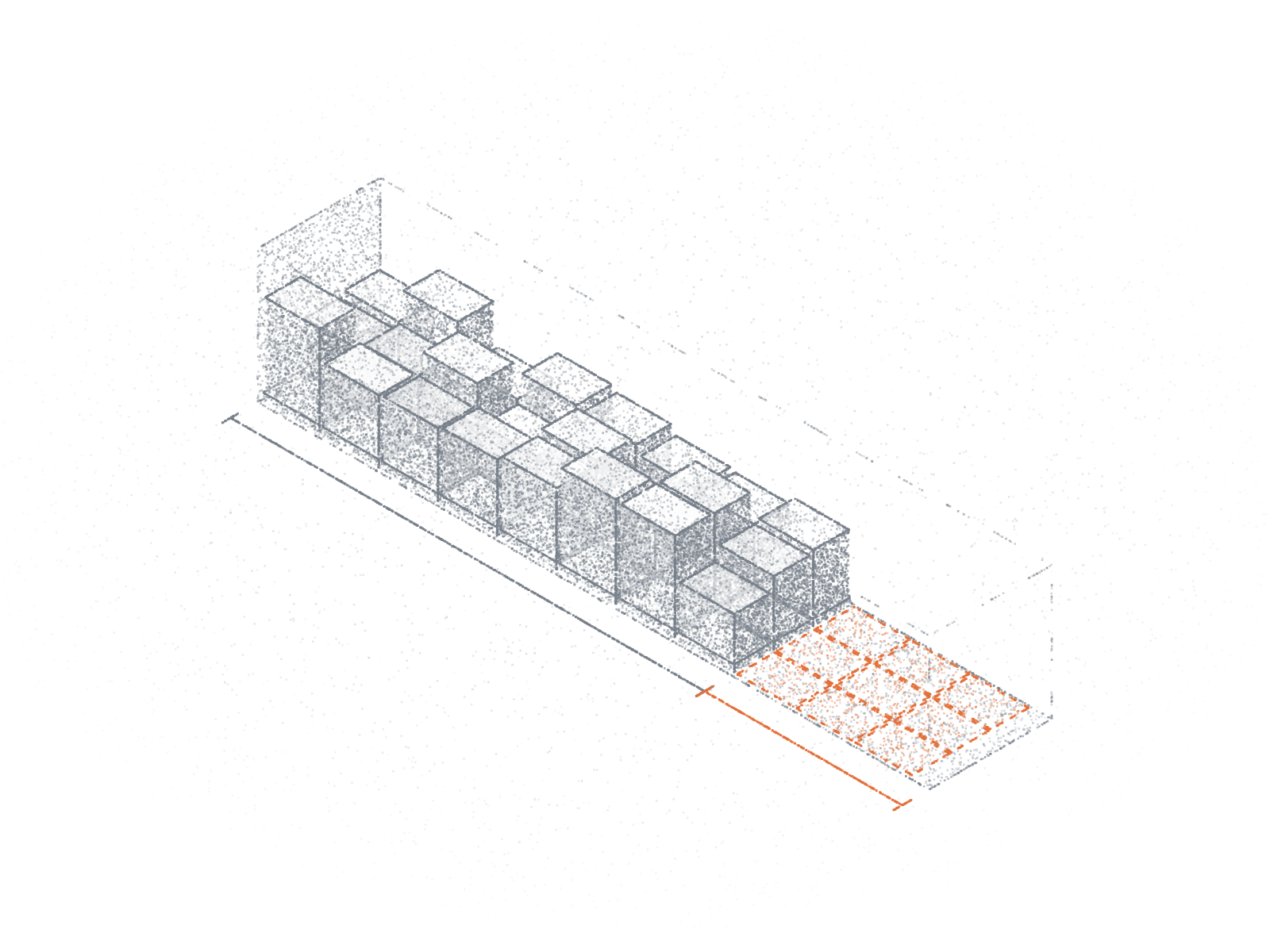
A standard 13.6 m trailer takes 33 Euro pallets on its floor, three across and eleven rows deep, and 34 if the last two rows are turned. It takes 26 industrial pallets. That answers how many fit on the floor. A 40-tonne artic carries about 24 tonnes of cargo, so a full floor of 33 is only possible if the pallets average 727 kg or less (923 kg for industrial pallets). Heavier freight fills the trailer by weight and leaves floor empty. Stacking two high doubles the count only for pallets up to 135 cm tall (150 cm in a mega trailer), and only if each weighs about 363 kg or less. This post goes through each of those limits, with the numbers from the Trailer fit tool.
33, 34 and 26: what fits on the floor
A curtainsider or box trailer is about 13.60 × 2.48 m inside. A Euro pallet is 1.2 × 0.8 m, so three fit side by side on their short edge, 2.4 m across, and each row is 1.2 m deep. Eleven rows take 13.2 m: that is 33 pallets, with 0.4 m left at the doors.
The 34th comes from turning the last two rows. A turned pallet puts its 1.2 m side across the trailer, so only two fit in a row, but the row is 0.8 m deep. Ten rows of three (12.0 m) and two turned rows of two (1.6 m) use exactly 13.60 m. Not a centimetre is spare: on a trailer 1 cm shorter the tool fits 33. Inner lengths of 13.5 to 13.6 m are common, and most published figures say 33.Carrier documents on the Trailer fit page give 13.5 × 2.48 × 2.63 m (DHL Freight Netherlands) and 13.6 × 2.45 × 2.60 m (DHL Freight Norway).
An industrial pallet (1.2 × 1.0 m) goes two across on its long edge, which fills the 2.4 m, and each row is 1.0 m deep. Thirteen rows use 13.0 m and the last 0.6 m is too short for another row, so 26 fit. The loading meter formula says otherwise: 13.6 ÷ 0.4 = 34 Euro pallets and 13.6 ÷ 0.5 = 27 industrial ones. The formula is a price unit, not a floor plan. It is what a carrier bills for the floor you take (why the invoice differs), not a count of what fits.
The weight limit: 40 t gross, about 24 t of cargo
In the EU a five- or six-axle articulated vehicle may weigh 40 t in international traffic, truck, trailer and load together.Directive 96/53/EC, Annex I, point 2.2.2(a) and (b). The same Annex sets 16.50 m length, 2.55 m width and 4.00 m height. The truck and trailer take a large part of that. One worked pair, a 4×2 tractor at 8,122 kg ready to drive and a curtainsider at 5,920 kg, comes to about 14 t, which leaves about 26 t on paper. Planners usually work with 24 t, which leaves room for heavier specifications and equipment, and the tool uses the same figure. Your own vehicles’ weights give the real number.
Divide that payload by the floor count and you get the heaviest average pallet that still fills the floor:
| Load | Pallets on the floor | Heaviest average pallet at 24,000 kg |
|---|---|---|
| Euro, usual layout | 33 | 727 kg |
| Euro, last rows turned | 34 | 705 kg |
| Industrial | 26 | 923 kg |
At 727 kg the tool loads 33 pallets at 23,991 kg. At 728 kg the same load is 24,024 kg and over. Pallets of a tonne fill the trailer at 24, with 9 places still empty. Dense goods reach the weight limit before the floor is full; light goods fill the floor first.
Axles: where the weight sits matters
A legal gross weight can still overload an axle. The Directive also limits each axle: 11.5 t on the tractor’s drive axle, and 24 t on a trailer’s triple axle (at 1.3 to 1.4 m spacing).Directive 96/53/EC, Annex I, points 3.3 and 3.4.1. Weight placed at the front of the trailer rests on the kingpin and so on the tractor’s drive axle; weight at the back rests on the trailer’s axles. Heavy pallets bunched at the front can overload the drive axle while the total stays under 40 t. Spread heavy pallets along the floor, or put the heavy ones over the trailer axles. The tool does not compute axle loads. The trailer maker’s load distribution diagram does.
Stacking: 135 cm is the line
Two pallets stacked take the floor of one. In a trailer 2.70 m high inside, two layers fit if each pallet, including the pallet itself, is at most 135 cm tall. Then a standard trailer takes 68 Euro pallets on 34 places, if they can bear each other and the trailer can carry them.
The weight limit comes back at once. 68 pallets at 130 cm and 400 kg are 27,200 kg, over the 24,000 kg payload. Stacked two high on the usual 33 places, 66 pallets, each can weigh about 363 kg on average. So stacking fills a trailer only for light goods, and those goods must also carry a pallet on top without crushing.
Stacked loads also need securing. UK guidance says standard curtains are not designed to secure a load, and straps or nets inside the curtain can hold loads only up to 400 kg; heavier palletised or stacked loads need more.GOV.UK, Securing loads on HGVs and goods vehicles, section 5. A body tested to EN 12642 XL holds at least 40% of its rated payload sideways. Whether a pallet counts as stackable is also a carrier rule, usually a height limit, and it changes the price (chargeable weight).
The mega trailer: the same floor, 30 cm more height
A mega trailer is 3.00 m high inside instead of 2.70 m, about 101 m³ against 91 m³. The floor is the same, so it still takes 33 or 34 Euro pallets and 26 industrial ones. Claims of 36 Euro pallets in a mega do not fit the floor. The extra height matters only for stackable pallets between 136 and 150 cm. At 145 cm and 300 kg, a standard trailer takes 34, because two do not fit under the roof. A mega takes 68, 20,400 kg, within the payload.
Containers: 11, 25, and the road after the port
ISO containers are narrower inside, about 2.35 m, so three Euro pallets no longer fit across and the counts are less round:
| Container | Euro pallets | Industrial pallets | Two high up to |
|---|---|---|---|
| 20 ft | 11 | 9 | 119 cm |
| 40 ft | 25 | 22 | 119 cm |
| 40 ft high cube | 25 | 22 | 134 cm |
A 40 ft box is rated for about 26.5 t of cargo, and the tool uses that rating: 25 Euro pallets of a tonne raise no warning. On the road the box travels on a chassis behind a tractor, and the whole vehicle falls under the road limit: 40 t, or 42 to 44 t for a container moving as part of an intermodal journey.Directive 96/53/EC, Annex I, point 2.2.2(c) and (d), for 40 and 45 ft ISO containers in combined transport. National limits differ. Tractor, chassis and box all come off that. A container that is legal at sea can be too heavy for the truck leg, so check the road weight before you load to the box rating.
Where this breaks
- Inner dimensions vary. The 34th pallet needs a full 13.60 m, and the 135 cm stacking line moves with the inner height (2.60 to 2.70 m is common). Measure the trailer you will get.
- 24 t is a planning figure, not a legal one. The real payload is 40 t minus your tractor and trailer as they leave the yard.
- National rules differ. Some countries allow 44 t domestically; crossing a border with it is not automatic.
- Axle loads are not checked by the tool. Position heavy pallets so no axle is overloaded.
- Stacking needs goods that bear a load, flat tops and securing. The tool divides the inner height by the pallet height and leaves no margin for forks or a gap under the roof.
- Other pallets change the count. 120 × 120 cm pallets, the 48 × 40 in North American pallet, overhanging loads and mixed loads all fit differently; the tool draws mixed loads.
- The law is being revised. A revision of Directive 96/53/EC has been in negotiation between the Parliament and the Council since December 2025, mostly about zero-emission and intermodal trucks. The figures here are the Directive in force on 7 November 2026.
Sources
- Directive 96/53/EC, Annex I (dimensions, gross weights, axle loads). EUR-Lex CELEX 01996L0053; readable copy at legislation.gov.uk.
- European Parliament, procedure 2023/0265(COD), revision of 96/53/EC. OEIL; state of negotiations: TrasportoEuropa, 2 Nov 2026.
- Tractor and trailer weights, worked pair (Ford F-MAX 4×2, Kögel Cargo P90): Loadoptima, citing the makers’ spec sheets.
- GOV.UK, Securing loads on HGVs and goods vehicles, section 5.
- Pallet counts, weights and stacking: the Trailer fit engine, inner sizes on the tool page.
A planning explanation, not loading advice. Counts are geometric and weights are planning figures; the vehicle’s papers, the carrier and national rules govern. Full notice on the tool page.
Keep reading
Linked from
More on freight markets
Topics: Freight markets, Warehousing & operations