EOQ vs minimum order quantity: what the supplier's minimum costs you
The economic order quantity (EOQ) is the order size with the lowest yearly cost of ordering plus holding stock. The minimum order quantity (MOQ) is the smallest order the supplier accepts. When the MOQ is above the EOQ you order the MOQ, and near the EOQ that costs little: in the example below the EOQ is 849 units, the minimum 1,000, and ordering 1,008 adds €25 a year. Far from the EOQ it is different: a minimum at twice the EOQ adds a quarter to the ordering and holding cost, at four times it more than doubles it. The bigger decision is usually the price break, and the same quote can mean opposite orders: 2,400 or 1,008. All numbers here come from the Order quantity tool.
The answer in one table
One item, one supplier quote. 1,000 units a month (12,000 a year), €8.00 a unit, €60 to place and receive an order, holding stock costs 25% of its value a year. The supplier sells in packs of 24, has a minimum order of 1,000 and offers €7.80 from 2,400 units. The tool adds one rule at a time:
| Step | Order | Cost a year (purchase + ordering + holding) | vs the EOQ |
|---|---|---|---|
| Textbook EOQ | 849 | €97,697 | |
| Rounded to the pack of 24 | 840 | €97,697 | ±€0 |
| Raised to the minimum order | 1,008 | €97,722 | +€25 |
| Price break, read as all-units | 2,400 | €96,240 | −€1,457 |
| Price break, read as incremental | 1,008 | €97,722 | +€25 |
The minimum is 1,000, but 1,000 is not a multiple of 24: the smallest order you can place is 1,008, 42 packs. The pack and the minimum together cost €25 a year. The price break is worth €1,482 a year, or nothing, depending on one word in the quote.
Why a minimum near the EOQ costs little
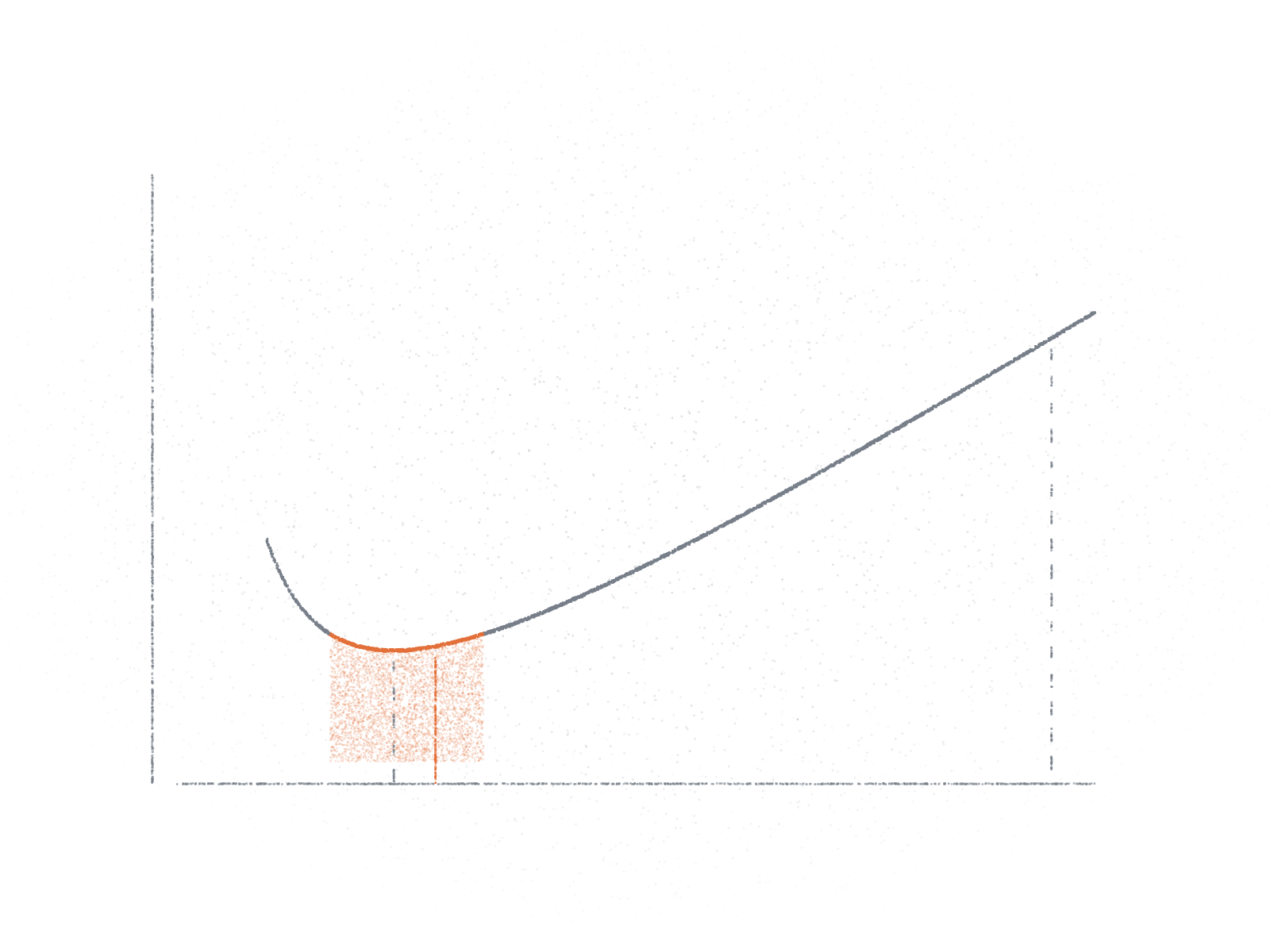
Ordering cost per year falls as the order grows (fewer orders); holding cost rises with it (more stock on average, half an order). Their sum has a wide, flat bottom. If x is the order size divided by the EOQ, ordering plus holding costs ½(x + 1/x) times its minimum:Caplice, MIT ESD.260 Logistics Systems, Lecture 7, slides 22–23 and 27: “Total cost is relatively insensitive to changes in … Q – rounding of order quantities”. The ratio covers ordering and holding only; the purchase cost does not change with the order size unless there is a price break.
| Order vs the EOQ | 1.25× | 1.5× | 2× | 3× | 4× |
|---|---|---|---|---|---|
| Ordering + holding vs its minimum | +2.5% | +8.3% | +25% | +67% | +113% |
In the example, ordering plus holding at the EOQ is €1,697 a year. Any order from 744 to 960 units (in packs of 24) stays within 1% of that, about €17 a year. The minimum of 1,000 is 1.18 times the EOQ, just past that band.
When the minimum gets expensive
The bottom is flat, the sides are not. The same item with higher minimums, no price break:
| Minimum | × EOQ | Order | Extra a year | Extra vs ordering + holding | Break-even price cut, € a unit |
|---|---|---|---|---|---|
| 1,000 | 1.2× | 1,008 | €25 | 1% | 0.002 |
| 1,700 | 2× | 1,704 | €429 | 25% | 0.035 |
| 2,550 | 3× | 2,568 | €1,151 | 68% | 0.093 |
| 3,400 | 4× | 3,408 | €1,922 | 113% | 0.155 |
The last column is the price cut per unit at which ordering the minimum costs no more a year than the best order without it. At four times the EOQ the extra cost is more than the whole ordering and holding bill at the EOQ, and the supplier would need to take about 1.9% off the price to make up for it. That is the number to bring to the supplier when you ask for a lower minimum, a price for smaller lots, or the minimum delivered in parts. The shares are slightly above ½(x + 1/x) because the orders are rounded up to whole packs.
One price break, two answers
The quote says “€7.80 from 2,400 units”. It can mean two things:
- All-units: an order of 2,400 or more pays €7.80 for every unit.
- Incremental: only the units above 2,400 pay €7.80; the first 2,400 still cost €8.00.
Read as all-units, ordering 2,400 saves €2,400 a year on purchases. You order 5 times a year instead of 11.9, and hold more stock: the net saving is €1,482 a year.
Read as incremental, an order of exactly 2,400 has no unit above the break: it still averages €8.00 a unit. The best order above the break is 2,568, which averages €7.987. That saves €157 a year on purchases and €434 on ordering, but adds €1,556 of holding, so it costs €965 a year more than staying at 1,008. Under this reading the break is not worth taking.
The price to ask for
For each break the tool also finds the highest price at which the break still pays, against the best order without it:
- All-units: the break pays at €7.92 or less. The quoted €7.80 has room to spare.
- Incremental: it pays only at €7.51 or less. That is the price to negotiate towards. And when an incremental break does pay, the best order goes far past the break: at €7.50 from 2,400 it is 4,008 units, not 2,400.
For the minimum order, the same question is the unit price: the minimum of 1,000 would cost nothing extra at €0.002 a unit off. A minimum this close to the EOQ is not worth negotiating; the ones at three or four times the EOQ are.
Pack sizes and rounding
The pack size moves the order to a multiple of the pack, and the flat bottom makes most packs cheap. With no minimum and no break:
| Pack | Best order | Extra a year vs the EOQ |
|---|---|---|
| 24 | 840 | €0 |
| 240 | 960 | €13 |
| 600 | 600 | €103 |
A pack of 600 is the costly one: the only multiples near the EOQ are 600 and 1200, both far from 849. Rounding a price-break order is different: with the all-units break the order cannot go below 2,400 without losing the price, so the room to round is one-sided, from 2,400 to 2,424.
Where it breaks
- Demand is taken as steady. The order size does not protect against a busy month or a late delivery; that is safety stock, with its own tool.
- One item at a time. Items that share an order, a truck or a minimum order value are not modelled.
- Freight that changes with the order size (a full truck against a part load) is not in the model; it goes into the cost per order as an average.
- The holding rate is yours to set. 25% a year is a common textbook planning figure (about 26% in Heizer and Render’s breakdown), mostly the cost of the money tied up. The EOQ moves only with the square root of the rate, so a rough figure costs little. In this example the two readings still split at 15% and at 35% a year: all-units 2,400 at both, incremental 1,104 and 1,008, below the break. Other quotes can tip, so try your own.
- Shelf life, cash and space can cap an order below what the cost curve likes. The tool takes a cap in months of demand.
Sources
- Harris, F. W. (1913). How many parts to make at once. Factory, The Magazine of Management, 10(2), 135–136. Reprinted in Operations Research, 38(6), 947–950 (1990).
- Caplice, C. (2006). ESD.260 Logistics Systems, Lecture 7 (EOQ and its sensitivity, slides 22–27) and Lecture 8 (quantity discounts, slides 10–15). MIT OpenCourseWare.
- Heizer, J., Render, B., & Munson, C. Operations Management. Pearson. Table 12.1, Determining inventory holding costs.
- Silver, E. A., Pyke, D. F., & Thomas, D. J. (2017). Inventory and Production Management in Supply Chains (4th ed.). CRC Press.
- All costs and orders: the Order quantity engine, with the example above.
Keep reading
Linked from
More on inventory & replenishment
Topics: Inventory & replenishment